Showing posts with label Collaboration. Show all posts

Saturday, September 15, 2012

Consensual Wisdom

I have a theory that almost all of us agree on almost everything. But we're wired somehow to zero in on the things we disagree about, however minor they may be, and debate/argue/fight over them. It seems the larger our base of common understanding, the more intense the disagreements over the details. Sunnis and Shiites, Christians and Muslims, Republicans and Democrats, kill each other (figuratively and sometimes literally) over the smallest ideological differences, despite their enormous shared premise. As a result, we ignore the big problems that challenge us all and focus instead on the minutiae of our dissonance.

But what if there were an environment where we were rewarded for finding our kernel of consensus? A game, say, where the rules guide us toward addressing the problems we all agree exist. An economy where one becomes individually wealthy only by taking actions that benefit everyone. A society that can grow as large and diverse as necessary and still make progress toward common goals.

I'm not talking about Utopia here. I'm just asking, is there a set of rewards and punishments, however artificially enforced, that will lead a group of people to focus on their considerable shared world view rather than their comparatively tiny differences?

Science, politics, and religion all have enormous edifices of consensual wisdom. Evidence and ideas that diverge from or seem to contradict those shared bodies of knowledge induce different reflexes in each discipline. Religious thinkers tend to reject them, scientists embrace them, and politicians use them as leverage. That's all fine, but the incessant preoccupation with what makes us different tends naturally to fragment us, to balkanize our churches, our research disciplines, and our societies until, in the limit, we will be left completely harmonious but quite alone. Social entropy will be at its maximum.

None of our institutions have evolved mechanisms of inclusion, systems that seek to expand groups by including more and more people who actually disagree with us. It's so rare that you may not even see the point in doing so. Maybe I am being hopelessly naive here, but it seems to me that recognizing our kernel of consensus, the common knowledge, shared problems, and joint solutions becomes more and more valuable as the size of the union gets larger, even if the intersection becomes smaller; particularly so if my hunch is correct that almost all of us agree on almost everything.

Perhaps I'm wrong though. Maybe, if all the religions of the world were to somehow identify their kernel of consensus, it would turn out to be trivial; something stupid and obvious like, we all have an ethical core and we should all give ourselves permission to obey it. But wait. Is that really so trivial? I, of course, don't know what the intersection of all our beliefs would be, but imagine the incredible power inherent in being able to make a statement like that! "We, the combined theological intelligentsia of the entire planet, believe the following to be true..." Imagine the societal and spiritual benefit that might ensue from simply communicating that consensus, whatever it turns out to be. I believe that benefit might far outweigh whatever good comes from arguing about who has the coolest prophet and whether we should utter its name or view its likeness.

I don't mean to pick on religion here. In many ways science is even less concerned with consensus and more obsessed with the deltas and outliers. That's what they do for a living, and it's what makes it so difficult for societies to choose courses of action based on reason and scientific consensus at a point in time. Many scientists believe it isn't their jobs to even try to identify consensus among themselves, rather they should provide politicians and decision-makers with all the possible alternatives and let them make decisions about what, if any actions to take. I think this is an abdication of their social responsibility. We are left to guess, infer, and in many cases, attempt to obfuscate scientific consensus on important topics.

Is the Earth's climate changing at a rate unprecedented in recorded history? I think I'm safe in saying almost all climate scientists agree that it is. Is this climate change anthropogenic (caused by human activities)? Maybe there's a consensus answer to that question, maybe not. Does evolution exist? Absolutely it does, in the same sense that quicksort (a well-known sorting algorithm) exists. Is it sufficient to explain the diversity of life on the planet? Without inviting criticism and controversy, I can't say whether there is a scientific consensus on that question. My point is, there are no conventional mechanisms in science for reaching and communicating conventional wisdom. Claiming that no consensus exists because one or a few scientists disagree is fallacious. Consensus does not require unanimity. It does, however, require a collaborative mechanism of discovery and refinement.

No, I'm not having a Kumbaya moment. My advanced age guarantees I have a healthy daily dose of skepticism and pessimism. The events of the past few days have done absolutely nothing to make me suddenly feel optimistic about our ability to live together without killing each other for nonsensical reasons.

But even with all this negative energy swirling around today, I'm left with an intellectual curiosity about the central question of this post: Now that the Internet has given the world a way to communicate instantly, can we also find a way to agree?

Wednesday, June 6, 2012

Democracy at Scale

Democracy is a flawed concept. Everybody knows it, and we have known it for many, many years. The principle problem with a pure democracy is, it doesn't scale. That's why large democratic institutions, notably the United States of America, are always something sort of like a democracy, but not quite. The U.S. is, of course, a republic. What's the difference between a democracy and a republic? James Madison explained it best in The Federalist #10.

The two great points of difference between a democracy and a republic are: first, the delegation of government, in the latter, to a small number of citizens elected by the rest; secondly, the greater number of citizens, and greater sphere of country, over which the latter may be extended.

The effect of the first difference is, on the one hand, to refine and enlarge the public views, by passing them through the medium of a chosen body of citizens, whose wisdom may best discern the true interest of their country, and whose patriotism and love of justice will be least likely to sacrifice it to temporary or partial considerations.

If that last part doesn't make your heart ache with nostalgia then you haven't paid much attention to U.S. politics for a long time. I personally cannot remember a time, and perhaps no one alive can remember a time, when the Congress of the United States consisted chiefly of citizens with enough wisdom, patriotism, and love of justice to refuse a lobbyist or vote against a good pork barrel spending bill in order to get reelected.

What happened? Are people fundamentally more corrupt than in the past? No, we are generally as selfish as always. The problem is, we have outgrown our system of government. Again. The brilliant idea of a republic, electing a small body of representatives who then govern among themselves by direct democracy (more or less), is inherently more scalable than pure democracy, but it also has its limits. Our numerous modern representatives — presidents, electors, congressmen, judges, mayors, city council members, constables (whatever those are) and so on — are often elected based not on their character, but on superficial bases like parentage, wealth, party affiliation, and hair style. That's largely because nobody has the time to really know and understand who these people are. And so we bestow enormous, disproportionate voting power to people based on silly criteria, including what they say they'll do in office, because we just don't have the time to examine their history to determine what they really believe in.

The answer, or at least one answer, can be found in the Ethosphere. Instead of voting for people to represent us, we might vote only on ideas, or their written embodiment that we call props. It's much easier to decide whether you are for or against an idea, a proposal, or a proposition, than it is to decide whether a complex person will be more or less likely to represent your own views. In order to scale, there will still be some citizens who have more voting power than others, but these representatives will be chosen based solely on their history of constructive participation in whatever society you both choose to be members. Citizens who write props that are eventually ratified by the voters at large will receive more voting power, as a side-effect of the normal activity of the group. Representatives can get elected only by constructive participation, not by campaigning.

This idea of conveying greater resources, in this case voting power or rep, to some individuals in order to increase the welfare of the entire group was first identified and discussed by a nineteenth century economist named Vilfredo Pareto. Pareto Inequality is exactly this somewhat paradoxical idea that the overall social welfare (measured by some metric) of a society can sometimes be increased by bestowing special powers or additional resources to small numbers of individuals.

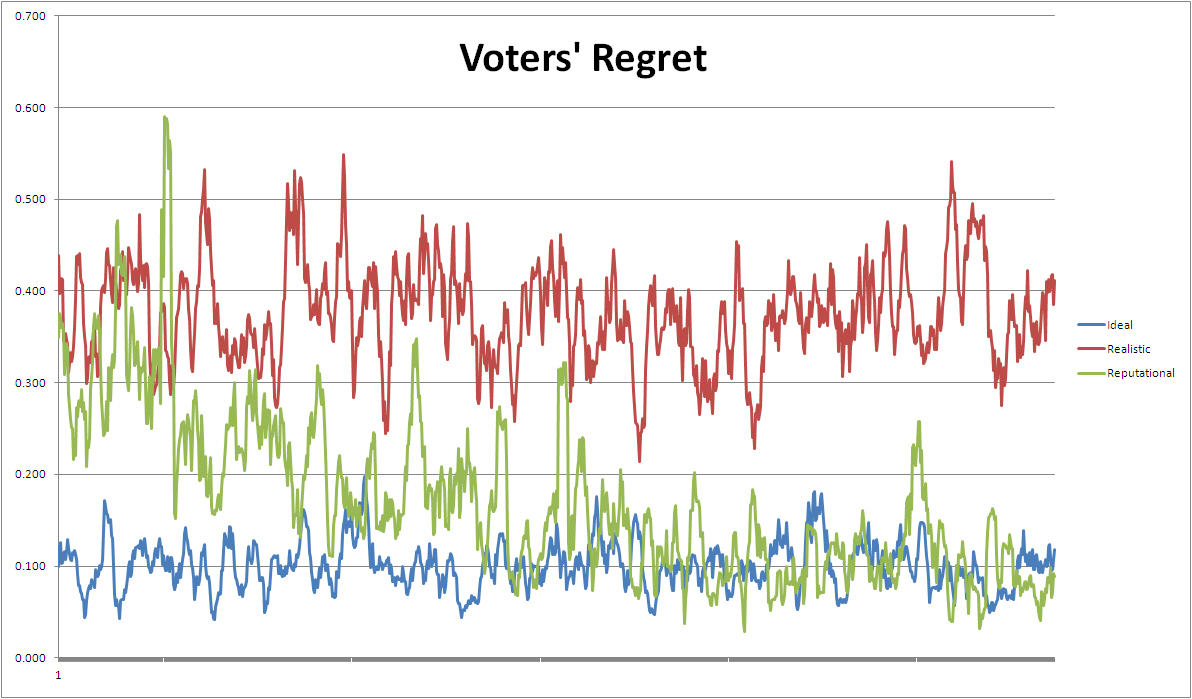
The question now becomes, can a reputational voting paradigm like the one I discussed in Building Ethos out of Logos actually result in a Pareto inequality and benefit the group as a whole by allowing the votes of those individuals with higher reputations to count more than others? To try to answer that question, I wrote a simple simulation. For the geeks out there, I'll describe the details of the simulation in a separate post. In general terms, it mimics the activities of five independent populations with 10,000 members in each. Props are proposed by randomly-chosen members and each member then votes on them based on its own internal preferences. A graphical summary of the results can be seen below. You might want to click on the graph to see the full-sized version.


The three plots display a measure of overall displeasure or regret after each of 1,000 props have been considered, voted upon, and either ratified or not. Regret is the inverse of social welfare, so lower regret numbers mean the system is doing a better job of identifying the population consensus. Under ideal conditions, when every voter is fully informed and there is 100% voter turnout, the result is the blue curve, which shows very low average regret. In other words, pure democracy works great when everyone participates and they have all the necessary information to accurately vote their individual preferences. Unfortunately, this is rarely the case for large populations.

The red curve shows what happens under more realistic circumstances, where only 40% of the population votes and only 25% of them are fully informed. Notice the overall regret numbers increase significantly, meaning more voters are more unhappy with the election results. The regret measurements include all voters, even those who didn't vote and those who didn't really understand what they voted for/against. As in real life, everyone has an opinion, even those who are too busy, too lazy, or too ignorant to express it by voting.

The green curve introduces reputational voting for the first time. We leave turnout percentage and informed percentage at 40% and 25% respectively, but each voter gets a boost in its reputation when it authors a prop that is eventually ratified by the population at large. Its rep is decreased when one of its props is rejected by the voters. Of course, each voter votes its current reputation, so voters who have more success historically in capturing the consensus of the whole group will eventually have higher reps and, therefore, disproportionately high voting power. As the green plot shows, this strategy starts off no better than the realistic scenario, but gradually gets better (lower regret numbers) until it has more or less completely compensated for the low turnout and poorly informed electorate. Thus, reputational voting does indeed implement a Pareto inequality by benefiting the population as a whole when additional resources (voting power) are granted to a small number of individuals.

There are other practical advantages of reputational versus representational (e.g. republics) systems that the simulation cannot show. Reputation is dynamic and continuously computed, which leads to a more robust system. Term limits are no longer necessary because reps increase and decrease over time based on recent history of constructive participation. Even when populations have shifting consensus opinions, which often happens, the reputation system is robust enough to shift with them. Also, reputation is computed as a side-effect of doing real work, proposing and voting on ideas, rather than as the side-show beauty contests representative elections often become. As I discussed in "Jane, You Ignorant Slut", it seems nobler to discuss ideas than people.

In order to bring democracy to the Internet, we will need to teach it to scale. As the above simulation shows, reputational voting is a straightforward mechanism that can help us do that.

Thursday, May 10, 2012

The Truth and Nothing But...a Good Story

A few months ago, a friend of mine who leans to the right politically shared a post on Facebook that started out like this:

Professor Joseph Olson of Hamline University School of Law in St. Paul, Minnesota, points out some interesting facts concerning the last Presidential election:
  • Number of States won by: Obama: 19 McCain: 29
  • Square miles of land won by: Obama: 580,000 McCain: 2,427,000
  • Population of counties won by: Obama: 127 million McCain: 143 million
  • Murder rate per 100,000 residents in counties won by: Obama: 13.2 McCain: 2.1

You may have seen this post, or even shared it yourself. By now, it is well known that it is a hoax, an urban legend, and almost every "fact" in it is false. By false, I mean provably incorrect, wrong, intentionally misleading, the opposite of the truth. A lie of the vicious variety. Thinking that my friend, an intelligent, honorable, well-educated man, must have just posted this Internet hoax without checking it out first, I commented on his post, helpfully (I thought) pointing out his mistake, including several links proving the thing is false.

But my friend simply deleted my comment and left the original post as it was, continuing to garner many "likes" from his like-minded friends. Incredulous, I commented again, this time asking, "Doesn't it bother you just a little that your post is utterly untrue?" His response was devastatingly brief, "Not one bit."

At this point I could have unfriended and written this guy off as just another whacked out Republican. But a few weeks later another friend, this time a left-leaning one, shared a news article in which Ann Romney is quoted as saying, "I mean really, all this wanting to be equal nonsense is going to be detrimental to the future of women everywhere." This time, my friend quickly realized this was a vicious fabrication (humorless satire isn't satire at all, just a lie). He posted a retraction and removed the original link. But instead of just saying, "I screwed up, please ignore," he said, and I'm paraphrasing here, the fact that so many people believed the article is an indication that it might be true, and in any case we should carefully consider the attitudes and positions of a potential First Lady before choosing her husband as president. In other words, if enough people find something to be plausible, it is likely to be at least partly true.

So it seems, on both sides of the political spectrum, we don't let the facts get in the way of a good story. And we never have. If you are a fan of Atlas Shrugged, Animal Farm, 1984, Lord of the Flies, The Republic, The Holy Bible, or almost any great work of literature, you know that a good story woven around a fictional set of "facts" is just as effective at shaping opinions, if not more so, than any dry set of statements, numbers, and statistics that have only the slightest advantage of being true. People are moved to action by narratives, not facts.

In Conflict, Compromise, and Consensus, I stated, "If one argues for an idea, or fights for it, it should be out of conviction the idea is righteous and true." In response to this, my good friend Dr. Russell Turpin points this out:

Among the most seductive of fallacies are the notions that believing something that is true must be advantageous, and conversely that believing what’s false is detrimental.

Well said. A good story is often more valuable than the truth. And facts are relative to the times and communities in which they are found. Ethics, however, are not -- at least not in my view. It is universally unethical to tell a good story based on facts you know to be false within your community. It is wrong to wield the terrible power of argumentation or war in defense of something you know to be a falsehood, even if it is to your advantage to do so.

Nevertheless, facts are rarely the best way to win an argument or an election. When faced with the necessity to choose between two alternatives in the real world, my favorite modern religious allegory, "The Life of Pi," supplies the answer in its final paragraphs. Which story makes you happiest?

Wednesday, April 11, 2012

Conflict, Compromise, and Consensus

The art of war and the art of debate are morally reprehensible courses of study. The first produces mercenaries and the second politicians. If one argues for an idea, or fights for it, it should be out of conviction the idea is righteous and true. The awesome weapons of war and argumentation should never be wielded for personal gain or self gratification.

Yet, this sort of rhetorical gamesmanship, where the object is to win the argument rather than advance society, is the most common form of political discourse today, and not just amongst politicians. It is an insidious, recreational form of what I call collaboration by conflict, wherein members of a group choose to engage each other specifically to find and argue about points of disagreement, however minor. In its non-recreational form, this type of collaboration can lead to positive societal advancement - think about the US Civil War or the civil rights movement - but usually at great cost and lingering dissatisfaction. More often than not, collaboration by conflict leads instead to splintering and balkanization of the group, even when the victors and the vanquished agree on almost everything! Catholics and protestants, Shi'ites and Sunnis, democrats and republicans, are far more alike in their ideologies than they are different. Yet, enormous human energy and (at least in the first two dichotomies) human lives have been wasted exploring the comparatively tiny differences.

A second type of collaboration is collaboration by compromise. If you and I have opposite ideas about something, we could seek a third alternative that is equally undesirable to both of us. Any well-functioning political body (insert oxymoron joke here) typically works using this form of collaboration. While it can produce a comfortable and stable society, collaboration by compromise generally does not result in great advances.

Finally, there is collaboration by consensus. If you and I have opposite ideas about something, we could seek a third, more fundamental alternative that we both strongly agree about and work to realize that idea. As an (admittedly over-trivialized) example, there is no overwhelming consensus among US citizens about abortion rights. Some believe it is a women's rights issue and that the mother should have complete discretion as long as the baby remains a part of her body. Others believe the moment there is even the potential for a human life to develop, it becomes the responsibility of society to protect and preserve that potential. And of course there is a whole spectrum of opinions in between those extremes. We citizens of the US could continue to battle it out over this issue, collaborating by conflict and enduring all the resultant costs and casualties. Or we could compromise again, as the Supreme Court did in Roe v. Wade, by choosing an arbitrary boundary and ensuring everyone is morally insulted in some cases. Or we might table this difficult and divisive fight and instead agree to work to reduce the number of unwanted pregnancies. And we might decide to expend all those resources we would otherwise have used arguing about abortion rights to instead streamline the adoption process and increase the pool of families who are willing and able to adopt. Collaborating by consensus, we can focus more of our time, money, and energy accomplishing the things for which there is widespread consensus, instead of wallowing in our differences and looking for another fight.

Truthfully, all three types of collaboration are needed to support any significantly meaningful society, online or offline. Ethosphere supports all three. More often than not though, the main goal of an Ethosphere collaboration is not to win. Nor is it to "split the baby" by finding compromises that nobody fully supports. Instead the goal is to find the kernel of consensus among a group of people on a given topic.

It is true, leaders don't seek consensus; they shape it. But don't mistake the day-to-day functioning of a society with leadership. And by all means don't try to conflate the role of government with the role of leader. It is not the responsibility of the US Congress, for example, to influence our opinions, rather to discern what those consensus opinions are and act on them.

Wednesday, March 14, 2012

"Jane, you ignorant slut."

"Dan, you pompous ass."
Remember the '70s when phrases like that in an SNL sketch were so outrageous, so over the top, they actually were kinda funny? Today, of course, those old Point / Counter Point sketches seem more prescient than outrageous, as "serious" news commentators routinely say things like this with the same calm, deliberate, faux intellectual deadpan Dan Aykroyd and Jane Curtin used back then. And it's not just talk radio where this occurs.

Most major online news outlets and blogs now allow readers to comment on op-ed pieces they publish. If you've ever read any of those commentary streams, you know they can quickly degrade into name calling and personal attacks, especially on those sites that allow commentators to post using anonymous pseudonyms. The grandiose idea that thousands of readers could contribute something constructive and positive to a thoughtful online conversation has been, to date, one of the most miserable failures associated with the Internet since its inception.

Nick Denton, the founder of Gawker Media and owner of a bunch of popular blogs, makes no bones about it. He says,  "It's a promise that has so not happened that people don't even have that ambition anymore. The idea of capturing the intelligence of the readership — that's a joke."

Why has this laudable Internet ambition been such an abject failure, and what, if anything can be done to fix it? I have spent the past few months reading thousands of comments attached to articles on a wide variety of topics.  To be sure, the effect is often depressing and sometimes frightening. But I do not think the reason this hasn't worked is a lack of intelligent people out there. On the contrary, I see many well-reasoned, well-written posts, some making points with which I agree and some with which I disagree. People still remember how to disagree with one another without ripping each other to shreds with ad hominem attacks. The trouble is, the constructive comments are often submerged in a cesspool of vile language, deliberate disinformation, intellectual immaturity, and troll bait.

I have developed a few tricks that help me leaf through the commentary streams quickly, identifying the comments that may have value and skipping the ones that probably should not have been written in the first place. One such trick is based on a quote often attributed to Eleanor Roosevelt,
"Great minds discuss ideas, average minds discuss events, small minds discuss people."
I've found you can quickly scan a post to determine whether the author is going to talk about ideas, events, or people. The first category are usually interesting, the second sometimes interesting, and the last almost never. Here are some examples from the commentary stream on the CNN article I linked above.
Ideas
@veggiedude - Siri (and IBM's Watson) has shown how well artificial intelligence can work. The solution is to employ a Siri type moderator to decide whether to post or not post the comments from the users. This way, a machine is in control, and there is no one to get mad at - unless a person 'enjoys' getting mad at a machine.
@maestro406 - Allow a "squelch" option. Everyone has the right to post, but that doesn't mean I have to read every comment from every poster. I should be able to block individual posters on my computer.
Events/Examples
@swohio - And the funny thing is, so many news sites have switched over to making people log in using Facebook in order to leave comments, stating it will help facilitate more mature, reasonable, and engaging discussion/comments. Sad to say, it hasn't at the sites I used to comment on where they've switched over to that system.
@GloriaBTM - The most enjoyable board I've posted on were IMDB around 2005-07, both because of the format, variety of topics, and the way it was moderated. (I'm not sure what it's like now...) We were able to have real conversations about current events, science, religion (and yes, movies), without have to wade through so much muck. Most importantly, posters whose posts were repeatedly deleted for violating T&C had their accounts deleted, fairly quickly. Yes, people could create new accounts, but it did slow the nastiness down.People could also IGNORE certain posters. It was brilliant. You just click ignore and you don't have to see them ever again.I found the format easier to navigate than any other board I've been on. Each thread could collapse (truly collapse, unlike here, where it still takes up space, though the message is blanked). Then you could quickly scroll through and find your conversation and open that thread.
People
@Tzckrl - STOOPID! R u kidding? Palin and Santarum 2012! Anyone who don't think so is a twerp!
@TommiGI - South by Southwest is a joke and Nick Denton is the punchline.
Another, sometimes more reliable, trick is to jot down the aliases of commentators who post useful or interesting comments and then scan for other comments by those same aliases. Of course, this is made more difficult if users are allowed to choose arbitrary, anonymous handles each time they log in. As @swohio indicates above, the recent tendency of other sites to require Facebook logins in order to try to enforce authenticity has had mixed results. While that approach doesn't seem to help moderate the crazies, as you might think it would, it does at least provide a consistent screen name for posters so that you can more easily spot the ones who have had a better track record in the past.

In Trust Me, I'm @HamsterOfDoom I talked about how a framework like the Ethosphere can help develop and maintain trust relationships with pseudonymous identities. By maintaining a numerical ranking, a rep as I call it in the Ethosphere, that reflects the degree to which an alias has contributed constructively to the community in the past, we can more easily filter out the noise while still allowing open participation. The trolls can still troll, but their influence in the group will be limited.

Another possible approach, proposed by Nick Denton in the linked interview, could have a similar impact.
The answer? Denton said his sites are planning to post some stories that allow only a hand-picked, pre-approved group of people to comment on them. That, he said, would make the comment section an extension of the story and allow people [...] to have their say without fear of being piled onto by others.
The fundamental difficulty with this approach is that someone else, the publisher?, anoints an elite few who may participate in the conversation. This is counter to the original goal of open participation and violates an unwritten Internet law just as much as requiring authentic logins would. A better solution is to allow the participants themselves to choose who should have proportionately greater influence, in a dynamic and ongoing fashion. In I'm Not Elitist, Just Better Than You, I discuss how and why this is done within the Ethosphere.

Do you think pseudonyms + reputation could be a possible solution to this problem?  Are there other self-policing, self-organizing ways to do this?

Thursday, March 8, 2012

Peer Pubs

The land of academic publishing and peer-reviewed journals is a strange land indeed. The business is dominated by a handful of publishing companies, notably the big four: Elsevier, Springer, John Wiley & Sons, and Informa. And don't think its just a niche market; those companies make tons of money and are hugely profitable. In the first quarter of 2011, Wiley made over $250 million with a profit margin of 43%! The largest of the four, Elsevier, made over $1.1 billion in 2010 and 36% of that went straight to the shareholders as profit. Wow. How in the world can there be such a giant market for publications like The Journal of Small Ruminant Research ("The official journal of the International Goat Association")? And why is it such a profitable business?
Well, here's how it works. These refereed journals are periodic anthologies of  scholarly papers and articles on fairly narrow topics (like goat research). They are written, understandably, by academics and researchers and they often document painstaking research and, sometimes, groundbreaking results in thousands of different fields of study. To ensure the accuracy, novelty, and relevance of these results, a long-standing peer review process has evolved in which highly reputable members of the same research community review, accept, or reject submissions. The collections are planned and organized usually by an editor, who is also a member of the same research community, like, for example, the community of researchers in the field of parallel and distributed computing.

Great!, you say. We want these smart, creative researchers to make gobs of money because they are actually adding huge value to our body of knowledge and, eventually, our economy as well. Out of those billions of dollars, how much does the author of one of these articles get paid? Well, nothing typically. They probably are getting a salary from a university or corporate research lab, and publishing research is considered part of their jobs, so they rarely get paid anything by the publishing companies. And besides, they get their name on the papers and enjoy all the fame and glory that comes from publishing a well-prepared, carefully researched treatise on ruminant husbandry or, ahem, byzantine agreement.

So what about the reviewers, whose names do not go up in lights? Yeah, they don't usually get paid either. Again, it's an expected part of their jobs. The editors? Nope.  It is such an honor to be asked to edit a series or even a volume of these prestigious publications that members of that same research community (heck, let's just call it a teamspace) do it for free. So basically, all the intellectual heavy lifting required to produce one of these journals is born by the teamspace itself with little or no monetary compensation expected.

The publishers keep all those $billions for themselves. But surely they provide some useful service, right? The answer is, they used to. In the old days, before the Internet, the publishers handled typesetting, copy editing, printing, distribution, and promotion (marketing). But today, either that stuff is being done by the teamspaces themselves (typesetting, copy editing, promotion) or simply isn't required anymore.  We love the Internet! It makes things cheaper for us consumers and more readily available to all of us. Since the hard work of peer-reviewed publishing is being done free of charge by all those various teamspaces, and since printing and distribution costs have essentially disappeared, I bet you think those journals and the research papers they contain can be had for a song now. Right?

Think again. A year's subscription to the Elsevier journal pictured above, just twelve issues, will cost a library about $1,200.  And that's the online cost! The publishers simply turn a switch  to give you access to somebody else's hard work and they charge you $100 per month per journal for that. University libraries must buy hundreds, perhaps thousands of these subscriptions and most researchers have little choice in the matter because they are required by their employers to publish in certain journals. The kind of open access we've come to expect on the Internet doesn't exist for these types of works, because the publishers make the authors sign over copyrights, again without compensation.  And then to pour salt on an already infected wound, the publishers spend some of that unearned revenue to lobby congress to pass vile, anti-competitive, anti-Internet laws with sickeningly misleading titles like the Research Works Act (RWA), the Stop Online Piracy Act (SOPA), and the Protect Intellectual Property Act (PIPA).

To state the obvious, the international research community is composed of a bunch of really smart folks, and they won't allow this situation to persist for too much longer. Already, nearly 8,000 of them have signed a petition, a bill of rights really, called The Cost of Knowledge, pledging to boycott Elsevier's publications. And there appears to be stirrings of a broader revolt against this ridiculous status quo in the blogosphere.

Most researchers agree that the only real value-add provided by the publishers in this scenario is to provide a framework in which peer review can take place. Not that they actually do the reviews, that's done by the peers themselves. But they provide a framework, a societal network where researchers on any particular topic can socialize, collaborate, swap critiques and comments, reach consensus about which papers to publish in a given issue, and recognize and honor those members who have contributed in a positive way to the body of knowledge. It turns out, reputation is big in academia.  Does this framework sound familiar?

The land of academic publishing will, almost inevitably, evolve into something like the Ethosphere. There's little doubt about this, in my opinion.  To phrase it another way, an Ethosphere teamspace as I've described it in this blog is nothing more nor less than a topical, peer-reviewed, online publication without the parasitic middlemen.

In the Ethosphere, perhaps knowledge needn't cost so much after all.

Sunday, March 4, 2012

Provably Probable Social Choice

There is a strong theoretical similarity between computer networks and people networks. Here we will discuss a surprising fact that has been proven to be true for both human and computer networks.

Without a coin to flip, there is no safe way for independent entities to reach consensus! 

The previous chapter contained a light treatment of a fairly heavy theoretical topic in computer science, Byzantine Agreement (BA), and an exploration of how randomness is an essential requirement in overcoming certain impossibility results in distributed computing. As it turns out, there are some tantalizingly strong similarities between the theory of distributed agreement and the theory of social choice (SC).

Recall that the BA problem setup involves a number of distributed processes each of which starts out with an initial value for some variable. We might call this initial value the "authentic" or "honest" value of a process, because all properly functioning processes will honestly report this value to all others. The goal of any BA algorithm is to allow the processes to vote for their authentic value and to compute, eventually, a global value in such a way that two straightforward requirements are met:
  1. If all well-behaved processes have the same authentic value, then the global consensus value must be that value.
  2. If the well-behaved processes do not all agree on the same authentic value, they must still agree on some global value; it doesn't matter which one.
To make it more interesting, the problem allows for the possibility of faulty processes that do not honestly report their authentic value choices but rather attempt to game the system to influence the agreed upon result, or to prevent any agreement from being reached. If we place no constraints at all on the types of failures the faulty processes can experience, then we may as well assume the nefarious nodes are consciously trying to thwart our algorithm and that they have complete access to all the information they need to do so.

Already we can start to see similarities between BA and SC (voting) problems. We have a number of independent processes (voters), each of which has its own preferred value (candidate) and they must report (vote) in order to agree on (elect) a global winner in a fair manner. Some of the entities may be faulty (dishonest) and instead report (vote) strategically, using information about partial results to unfairly game the system in favor of their authentic choice.
Terminology note: The social choice literature seems to use the terms "strategic voting" and "tactical voting" interchangeably to mean voting for some candidate who is not your authentically preferred one in order to try to influence the election in your favor. Here we will use "tactical voting" because it describes better what's actually going on.
A very interesting question to ask for both BA and SC is this: Is it possible to devise an algorithm in which the non-faulty (honest) processes (voters) can overcome the evil impact of one or a few faulty (dishonest) ones so they cannot unfairly influence the result?  Not surprisingly, many mathematicians have examined this and similar questions and, perhaps surprisingly, the answers have been rather discouraging.

In the area of Byzantine Agreement, it was proven in 1985 that, for any practical scenario (where, e.g.,  message delivery times are unpredictable) there is no deterministic algorithm that will prevent even a single faulty process from influencing the results of the agreement. All the great work and research to find solutions in this area depends on randomness in some way to solve this important problem.

So what about the Social Choice arena? Around the same time (1984) Michael Dummett published several proofs of a decade-old conjecture now called the Gibbard-Satterthwaite theorem which is about voting algorithms used to select one winner from a group of three or more candidates based on voters' preferences. To paraphrase, the theorem states that for any reasonable scenario (where, e.g., there are no blacklisted candidates and the winner is not chosen by a single dictator) there is no deterministic algorithm that will prevent even a single tactical voter from influencing the results of the election. Sound familiar?

There is a more well-known, but in some ways less interesting, result in social choice called Arrow's Impossibility Theorem that has a lot in common with the G-S theorem discussed above. Dr. Kenneth Arrow received the Nobel Prize in Economics for his work related to this theorem in 1972. Professor Nancy Lynch received the Knuth Prize in 2007, in part for her seminal work on the impossibility proof for Byzantine Agreement. Yet, as near as I can tell, neither discipline has cited the other in all these years, despite the striking similarities of the problems and results and the huge amount of research activity associated with the two independent fields.

Don't get me wrong. I'm not saying these two canonical problems are identical, or even that there is a common underlying body of theory (though I believe there very well might me). But even the differences in the problem statements are illuminating and may indicate areas for further research in one field or the other. For example, the BA problem statement requires every non-faulty process be able to independently compute and verify the agreed upon value. There is no central authority to tabulate votes in BA, whereas in SC, it is typically assumed the independent voters submit their preferences which are then tallied in one place by a trusted central authority. But would it be a useful requirement for each voter in a SC scenario to be able to independently verify the results of an election? I believe this could be the basis of a reasonable formal definition of election transparency, a very useful property of real elections.

There are also areas where the typical formulations of SC problems are actually more stringent than BA. Remember the validity requirement for BA is, if every non-faulty process begins with the exact same initial value, then the algorithm must choose that value. If even one good process has a different value, then a correct BA algorithm is free to choose any value at all, as long as everyone agrees with it in the end. For SC, however, we must agree to elect a candidate based on more flexible requirements. An alternative validity rule might be, if a plurality of non-faulty processes have the same preferred value, the algorithm must choose that value. Or more generally, the algorithm must choose the winning candidate such that voters are the least unhappy about the result. This suggests some interesting extensions to the BA problem, such as Synchronous Byzantine Plurality.  I have no idea whether that problem has been studied or results reported in the literature, but reasoning by analogy (always a tricky thing to do) with the Gibbard-Satterthwait theorem, I would guess that synchronous BA with a plurality rather than unanimity constraint would be impossible in a deterministic way.

Despite all the interesting complexities with these two fields of study, one can definitively say that no completely robust solution to either BA or SC is possible without randomness. Faulty and/or malicious participants can always overwhelm honest participants to influence agreements and elections.  Without a coin to flip, there is no safe way for independent entities to reach consensus!

Wednesday, February 22, 2012

Pull the Curtain and Vote

Voting in Ethosphere (and any other online venue for that matter) must take into account a troublesome but unavoidable fact of Internet life — members/users can lie about who they really are. A senator can pretend to be an ordinary citizen, a law enforcement officer can pretend to be a teenage boy, and a middle-aged, married American man can pretend to be a gay girl in Damascus. Elections in Real Life (RL), especially in the US, require us to pull the curtain, as it were, to carefully obfuscate the connection between a person's true identity, his satnam, and the ballots he casts.

Facebook, among others, is discovering how difficult it is to ensure that user logins are associated with real, authentic people and that each person has only one such login. While other social networks, notably Twitter, allow users to have as many pseudonyms, aliases, as they wish and do not try to enforce authenticity with RL identities. There are advantages and disadvantages to each approach. Apart from the technical impracticality of verifying users' true identities, there are some unexpected bonuses in allowing members to assume an alias, or many aliases, that can never, as a matter of principle, be traced back to the owner's true name.

But the only way to be able to maintain a trust relationship, including consensus building and voting, with such pseudonymous members is to associate and maintain a reputation of some sort for each persona. The Ethosphere does this using a straightforward mechanism. Each member has an associated rep, which is simply a non-negative real number. A member that happens to be a part of more than one teamspace will have a different rep in each space. Upon first joining a new team, a member's rep within that team is initialized to 0.0. Reps cannot be directly manipulated, but they can be bumped (increased) or busted (decreased) as a result of certain activities within a teamspace. In general terms, a member's rep increases as a side-effect of constructive participation within the teamspace.

The degree of influence a given member has within a teamspace is directly proportional to its rep. To be precise, when a member casts a vote for a prop within a teamspace, her vote counts only so much as her current rep within that teamspace. Older, established members contribute stability and robustness to the society, but nothing prevents new members from building up their own reps and, eventually, exerting their own guidance and influence. Ethosphere is a pure meritocracy.

By allowing pseudonyms with their associated reps (let's call those pairs personae), and diligently protecting the connection between a persona and a real life identity, we have effectively moved the curtain. Online elections can now be completely transparent, publishing exactly which persona voted for which prop, fostering trust in the electoral machinery and the voting algorithms. But at the same time, nobody will ever know that, for example, Jim Dutton voted yea or nay on a given prop. As with Twitter aliases, members will feel freer to express themselves and their opinions without fear of reprisals or embarrassment from their RL friends and families. Unlike Twitter, Ethosphere personae are more likely to show restraint and consideration in their teamspaces to preserve and improve their reps, and thus their future influence.