Showing posts with label Reputation. Show all posts

Wednesday, June 6, 2012

Democracy at Scale

Democracy is a flawed concept. Everybody knows it, and we have known it for many, many years. The principle problem with a pure democracy is, it doesn't scale. That's why large democratic institutions, notably the United States of America, are always something sort of like a democracy, but not quite. The U.S. is, of course, a republic. What's the difference between a democracy and a republic? James Madison explained it best in The Federalist #10.

The two great points of difference between a democracy and a republic are: first, the delegation of government, in the latter, to a small number of citizens elected by the rest; secondly, the greater number of citizens, and greater sphere of country, over which the latter may be extended.

The effect of the first difference is, on the one hand, to refine and enlarge the public views, by passing them through the medium of a chosen body of citizens, whose wisdom may best discern the true interest of their country, and whose patriotism and love of justice will be least likely to sacrifice it to temporary or partial considerations.

If that last part doesn't make your heart ache with nostalgia then you haven't paid much attention to U.S. politics for a long time. I personally cannot remember a time, and perhaps no one alive can remember a time, when the Congress of the United States consisted chiefly of citizens with enough wisdom, patriotism, and love of justice to refuse a lobbyist or vote against a good pork barrel spending bill in order to get reelected.

What happened? Are people fundamentally more corrupt than in the past? No, we are generally as selfish as always. The problem is, we have outgrown our system of government. Again. The brilliant idea of a republic, electing a small body of representatives who then govern among themselves by direct democracy (more or less), is inherently more scalable than pure democracy, but it also has its limits. Our numerous modern representatives — presidents, electors, congressmen, judges, mayors, city council members, constables (whatever those are) and so on — are often elected based not on their character, but on superficial bases like parentage, wealth, party affiliation, and hair style. That's largely because nobody has the time to really know and understand who these people are. And so we bestow enormous, disproportionate voting power to people based on silly criteria, including what they say they'll do in office, because we just don't have the time to examine their history to determine what they really believe in.

The answer, or at least one answer, can be found in the Ethosphere. Instead of voting for people to represent us, we might vote only on ideas, or their written embodiment that we call props. It's much easier to decide whether you are for or against an idea, a proposal, or a proposition, than it is to decide whether a complex person will be more or less likely to represent your own views. In order to scale, there will still be some citizens who have more voting power than others, but these representatives will be chosen based solely on their history of constructive participation in whatever society you both choose to be members. Citizens who write props that are eventually ratified by the voters at large will receive more voting power, as a side-effect of the normal activity of the group. Representatives can get elected only by constructive participation, not by campaigning.

This idea of conveying greater resources, in this case voting power or rep, to some individuals in order to increase the welfare of the entire group was first identified and discussed by a nineteenth century economist named Vilfredo Pareto. Pareto Inequality is exactly this somewhat paradoxical idea that the overall social welfare (measured by some metric) of a society can sometimes be increased by bestowing special powers or additional resources to small numbers of individuals.

The question now becomes, can a reputational voting paradigm like the one I discussed in Building Ethos out of Logos actually result in a Pareto inequality and benefit the group as a whole by allowing the votes of those individuals with higher reputations to count more than others? To try to answer that question, I wrote a simple simulation. For the geeks out there, I'll describe the details of the simulation in a separate post. In general terms, it mimics the activities of five independent populations with 10,000 members in each. Props are proposed by randomly-chosen members and each member then votes on them based on its own internal preferences. A graphical summary of the results can be seen below. You might want to click on the graph to see the full-sized version.
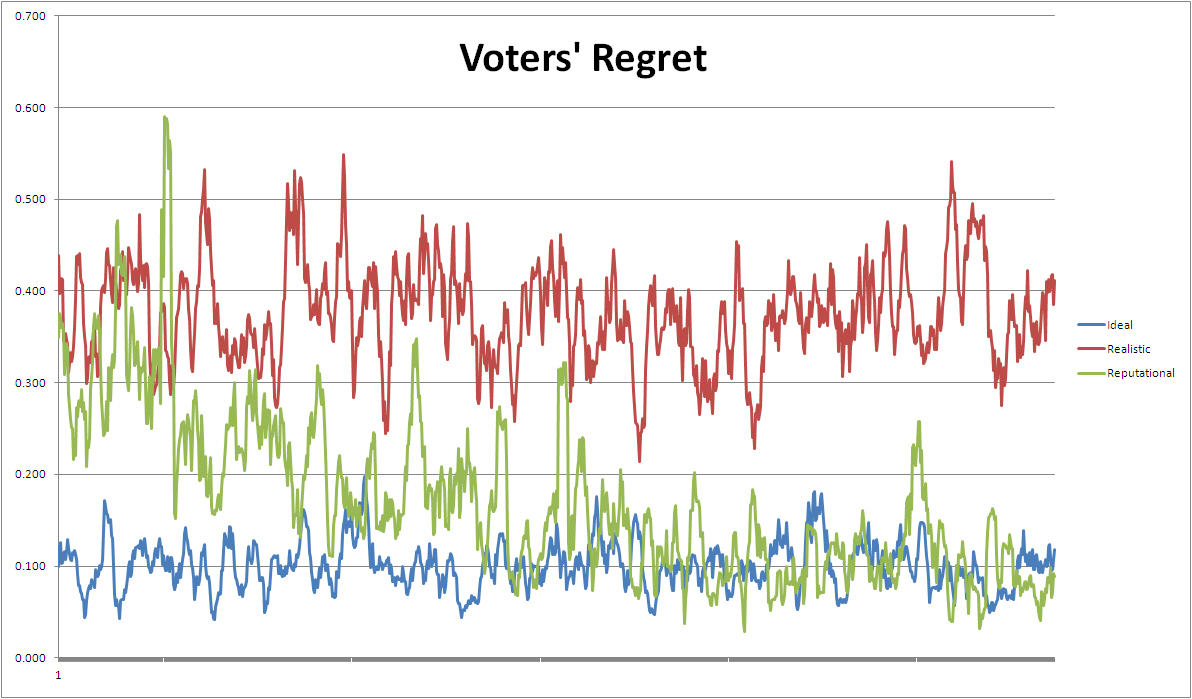

The three plots display a measure of overall displeasure or regret after each of 1,000 props have been considered, voted upon, and either ratified or not. Regret is the inverse of social welfare, so lower regret numbers mean the system is doing a better job of identifying the population consensus. Under ideal conditions, when every voter is fully informed and there is 100% voter turnout, the result is the blue curve, which shows very low average regret. In other words, pure democracy works great when everyone participates and they have all the necessary information to accurately vote their individual preferences. Unfortunately, this is rarely the case for large populations.

The red curve shows what happens under more realistic circumstances, where only 40% of the population votes and only 25% of them are fully informed. Notice the overall regret numbers increase significantly, meaning more voters are more unhappy with the election results. The regret measurements include all voters, even those who didn't vote and those who didn't really understand what they voted for/against. As in real life, everyone has an opinion, even those who are too busy, too lazy, or too ignorant to express it by voting.

The green curve introduces reputational voting for the first time. We leave turnout percentage and informed percentage at 40% and 25% respectively, but each voter gets a boost in its reputation when it authors a prop that is eventually ratified by the population at large. Its rep is decreased when one of its props is rejected by the voters. Of course, each voter votes its current reputation, so voters who have more success historically in capturing the consensus of the whole group will eventually have higher reps and, therefore, disproportionately high voting power. As the green plot shows, this strategy starts off no better than the realistic scenario, but gradually gets better (lower regret numbers) until it has more or less completely compensated for the low turnout and poorly informed electorate. Thus, reputational voting does indeed implement a Pareto inequality by benefiting the population as a whole when additional resources (voting power) are granted to a small number of individuals.

There are other practical advantages of reputational versus representational (e.g. republics) systems that the simulation cannot show. Reputation is dynamic and continuously computed, which leads to a more robust system. Term limits are no longer necessary because reps increase and decrease over time based on recent history of constructive participation. Even when populations have shifting consensus opinions, which often happens, the reputation system is robust enough to shift with them. Also, reputation is computed as a side-effect of doing real work, proposing and voting on ideas, rather than as the side-show beauty contests representative elections often become. As I discussed in "Jane, You Ignorant Slut", it seems nobler to discuss ideas than people.

In order to bring democracy to the Internet, we will need to teach it to scale. As the above simulation shows, reputational voting is a straightforward mechanism that can help us do that.

Wednesday, March 14, 2012

"Jane, you ignorant slut."

"Dan, you pompous ass."
Remember the '70s when phrases like that in an SNL sketch were so outrageous, so over the top, they actually were kinda funny? Today, of course, those old Point / Counter Point sketches seem more prescient than outrageous, as "serious" news commentators routinely say things like this with the same calm, deliberate, faux intellectual deadpan Dan Aykroyd and Jane Curtin used back then. And it's not just talk radio where this occurs.

Most major online news outlets and blogs now allow readers to comment on op-ed pieces they publish. If you've ever read any of those commentary streams, you know they can quickly degrade into name calling and personal attacks, especially on those sites that allow commentators to post using anonymous pseudonyms. The grandiose idea that thousands of readers could contribute something constructive and positive to a thoughtful online conversation has been, to date, one of the most miserable failures associated with the Internet since its inception.

Nick Denton, the founder of Gawker Media and owner of a bunch of popular blogs, makes no bones about it. He says,  "It's a promise that has so not happened that people don't even have that ambition anymore. The idea of capturing the intelligence of the readership — that's a joke."

Why has this laudable Internet ambition been such an abject failure, and what, if anything can be done to fix it? I have spent the past few months reading thousands of comments attached to articles on a wide variety of topics.  To be sure, the effect is often depressing and sometimes frightening. But I do not think the reason this hasn't worked is a lack of intelligent people out there. On the contrary, I see many well-reasoned, well-written posts, some making points with which I agree and some with which I disagree. People still remember how to disagree with one another without ripping each other to shreds with ad hominem attacks. The trouble is, the constructive comments are often submerged in a cesspool of vile language, deliberate disinformation, intellectual immaturity, and troll bait.

I have developed a few tricks that help me leaf through the commentary streams quickly, identifying the comments that may have value and skipping the ones that probably should not have been written in the first place. One such trick is based on a quote often attributed to Eleanor Roosevelt,
"Great minds discuss ideas, average minds discuss events, small minds discuss people."
I've found you can quickly scan a post to determine whether the author is going to talk about ideas, events, or people. The first category are usually interesting, the second sometimes interesting, and the last almost never. Here are some examples from the commentary stream on the CNN article I linked above.
Ideas
@veggiedude - Siri (and IBM's Watson) has shown how well artificial intelligence can work. The solution is to employ a Siri type moderator to decide whether to post or not post the comments from the users. This way, a machine is in control, and there is no one to get mad at - unless a person 'enjoys' getting mad at a machine.
@maestro406 - Allow a "squelch" option. Everyone has the right to post, but that doesn't mean I have to read every comment from every poster. I should be able to block individual posters on my computer.
Events/Examples
@swohio - And the funny thing is, so many news sites have switched over to making people log in using Facebook in order to leave comments, stating it will help facilitate more mature, reasonable, and engaging discussion/comments. Sad to say, it hasn't at the sites I used to comment on where they've switched over to that system.
@GloriaBTM - The most enjoyable board I've posted on were IMDB around 2005-07, both because of the format, variety of topics, and the way it was moderated. (I'm not sure what it's like now...) We were able to have real conversations about current events, science, religion (and yes, movies), without have to wade through so much muck. Most importantly, posters whose posts were repeatedly deleted for violating T&C had their accounts deleted, fairly quickly. Yes, people could create new accounts, but it did slow the nastiness down.People could also IGNORE certain posters. It was brilliant. You just click ignore and you don't have to see them ever again.I found the format easier to navigate than any other board I've been on. Each thread could collapse (truly collapse, unlike here, where it still takes up space, though the message is blanked). Then you could quickly scroll through and find your conversation and open that thread.
People
@Tzckrl - STOOPID! R u kidding? Palin and Santarum 2012! Anyone who don't think so is a twerp!
@TommiGI - South by Southwest is a joke and Nick Denton is the punchline.
Another, sometimes more reliable, trick is to jot down the aliases of commentators who post useful or interesting comments and then scan for other comments by those same aliases. Of course, this is made more difficult if users are allowed to choose arbitrary, anonymous handles each time they log in. As @swohio indicates above, the recent tendency of other sites to require Facebook logins in order to try to enforce authenticity has had mixed results. While that approach doesn't seem to help moderate the crazies, as you might think it would, it does at least provide a consistent screen name for posters so that you can more easily spot the ones who have had a better track record in the past.

In Trust Me, I'm @HamsterOfDoom I talked about how a framework like the Ethosphere can help develop and maintain trust relationships with pseudonymous identities. By maintaining a numerical ranking, a rep as I call it in the Ethosphere, that reflects the degree to which an alias has contributed constructively to the community in the past, we can more easily filter out the noise while still allowing open participation. The trolls can still troll, but their influence in the group will be limited.

Another possible approach, proposed by Nick Denton in the linked interview, could have a similar impact.
The answer? Denton said his sites are planning to post some stories that allow only a hand-picked, pre-approved group of people to comment on them. That, he said, would make the comment section an extension of the story and allow people [...] to have their say without fear of being piled onto by others.
The fundamental difficulty with this approach is that someone else, the publisher?, anoints an elite few who may participate in the conversation. This is counter to the original goal of open participation and violates an unwritten Internet law just as much as requiring authentic logins would. A better solution is to allow the participants themselves to choose who should have proportionately greater influence, in a dynamic and ongoing fashion. In I'm Not Elitist, Just Better Than You, I discuss how and why this is done within the Ethosphere.

Do you think pseudonyms + reputation could be a possible solution to this problem?  Are there other self-policing, self-organizing ways to do this?

Thursday, March 8, 2012

Peer Pubs

The land of academic publishing and peer-reviewed journals is a strange land indeed. The business is dominated by a handful of publishing companies, notably the big four: Elsevier, Springer, John Wiley & Sons, and Informa. And don't think its just a niche market; those companies make tons of money and are hugely profitable. In the first quarter of 2011, Wiley made over $250 million with a profit margin of 43%! The largest of the four, Elsevier, made over $1.1 billion in 2010 and 36% of that went straight to the shareholders as profit. Wow. How in the world can there be such a giant market for publications like The Journal of Small Ruminant Research ("The official journal of the International Goat Association")? And why is it such a profitable business?
Well, here's how it works. These refereed journals are periodic anthologies of  scholarly papers and articles on fairly narrow topics (like goat research). They are written, understandably, by academics and researchers and they often document painstaking research and, sometimes, groundbreaking results in thousands of different fields of study. To ensure the accuracy, novelty, and relevance of these results, a long-standing peer review process has evolved in which highly reputable members of the same research community review, accept, or reject submissions. The collections are planned and organized usually by an editor, who is also a member of the same research community, like, for example, the community of researchers in the field of parallel and distributed computing.

Great!, you say. We want these smart, creative researchers to make gobs of money because they are actually adding huge value to our body of knowledge and, eventually, our economy as well. Out of those billions of dollars, how much does the author of one of these articles get paid? Well, nothing typically. They probably are getting a salary from a university or corporate research lab, and publishing research is considered part of their jobs, so they rarely get paid anything by the publishing companies. And besides, they get their name on the papers and enjoy all the fame and glory that comes from publishing a well-prepared, carefully researched treatise on ruminant husbandry or, ahem, byzantine agreement.

So what about the reviewers, whose names do not go up in lights? Yeah, they don't usually get paid either. Again, it's an expected part of their jobs. The editors? Nope.  It is such an honor to be asked to edit a series or even a volume of these prestigious publications that members of that same research community (heck, let's just call it a teamspace) do it for free. So basically, all the intellectual heavy lifting required to produce one of these journals is born by the teamspace itself with little or no monetary compensation expected.

The publishers keep all those $billions for themselves. But surely they provide some useful service, right? The answer is, they used to. In the old days, before the Internet, the publishers handled typesetting, copy editing, printing, distribution, and promotion (marketing). But today, either that stuff is being done by the teamspaces themselves (typesetting, copy editing, promotion) or simply isn't required anymore.  We love the Internet! It makes things cheaper for us consumers and more readily available to all of us. Since the hard work of peer-reviewed publishing is being done free of charge by all those various teamspaces, and since printing and distribution costs have essentially disappeared, I bet you think those journals and the research papers they contain can be had for a song now. Right?

Think again. A year's subscription to the Elsevier journal pictured above, just twelve issues, will cost a library about $1,200.  And that's the online cost! The publishers simply turn a switch  to give you access to somebody else's hard work and they charge you $100 per month per journal for that. University libraries must buy hundreds, perhaps thousands of these subscriptions and most researchers have little choice in the matter because they are required by their employers to publish in certain journals. The kind of open access we've come to expect on the Internet doesn't exist for these types of works, because the publishers make the authors sign over copyrights, again without compensation.  And then to pour salt on an already infected wound, the publishers spend some of that unearned revenue to lobby congress to pass vile, anti-competitive, anti-Internet laws with sickeningly misleading titles like the Research Works Act (RWA), the Stop Online Piracy Act (SOPA), and the Protect Intellectual Property Act (PIPA).

To state the obvious, the international research community is composed of a bunch of really smart folks, and they won't allow this situation to persist for too much longer. Already, nearly 8,000 of them have signed a petition, a bill of rights really, called The Cost of Knowledge, pledging to boycott Elsevier's publications. And there appears to be stirrings of a broader revolt against this ridiculous status quo in the blogosphere.

Most researchers agree that the only real value-add provided by the publishers in this scenario is to provide a framework in which peer review can take place. Not that they actually do the reviews, that's done by the peers themselves. But they provide a framework, a societal network where researchers on any particular topic can socialize, collaborate, swap critiques and comments, reach consensus about which papers to publish in a given issue, and recognize and honor those members who have contributed in a positive way to the body of knowledge. It turns out, reputation is big in academia.  Does this framework sound familiar?

The land of academic publishing will, almost inevitably, evolve into something like the Ethosphere. There's little doubt about this, in my opinion.  To phrase it another way, an Ethosphere teamspace as I've described it in this blog is nothing more nor less than a topical, peer-reviewed, online publication without the parasitic middlemen.

In the Ethosphere, perhaps knowledge needn't cost so much after all.

Friday, March 2, 2012

Privacy Through Multiplicity

Internet privacy is a big deal and will become an even bigger deal as web-based software to track clickstreams and collect personal information continues to become more effective. As an Internet user, I don't want web sites to be able to conspire to build and maintain a complete picture of my online activities. I want to be able to protect personal information about myself (e.g., credit card #, home address, business email, demographic info) from the prying eyes of web sites that I may casually visit. It would seem that Ethosphere would provide the ultimate in user privacy, since the privacy directive prevents a web site administrator (or anyone else) from discovering the true identity of a persona. However, this may not be enough.

Suppose I always use the same persona, named @UncleAlbert, within Ethosphere. During the day, @UncleAlbert works as a trusted financial advisor, but he is also interested in hang gliding and, being a single person, occasionally hangs out in a singles-only online club. @UncleAlbert also buys books from amazon.com, rents movies from netflix.com, and he owns a laptop he bought on ebay.com. By simply tracking @UncleAlbert's interests and activities on the Internet, an observer could learn a great deal about the person who "owns" @UncleAlbert in RL. The privacy directive would not allow disclosure of the person's real home address or age or gender, but it would still allow some pretty powerful inferences to be made regarding his or her lifestyle and buying habits.

Within the Ethosphere, this sort of inference-by-clickstream invasion of privacy could easily be thwarted by simply using many different personae. For example, if I create a new persona each time I log on to the network (assuming persona creation is cheap and easy), there would be no way for anyone to connect the behavior of one persona with any of the others, and each persona would therefore be completely anonymous. Unfortunately, this strategy would also make any kind of long term relationship, including business and commerce, impossible. Who would trust or choose to associate with an anonymous persona? Privacy is not the same as anonymity.

It is necessary, it seems, for personae to have associated, recognizable characters or personalities that persist across logins. Nobody would trust financial advice from @UncleAlbert (nor be willing to pay for it) without some kind of credentials or track record that indicates he knows what he's talking about. Moreover, if the system maintains that reputation and provides it to clients or even competitors in the financial community, this doesn't really seem to raise any privacy concerns (even though it might possibly be professionally harmful to @UncleAlbert). If a client chooses to record some praise or criticism of Al's work, it seems fair to @UncleAlbert and to other clients and potential clients that this bit of information be made available to them. On the other hand, if the system maintained and provided information about @UncleAlbert's other interests, say hang gliding, to clients or competitors, this does seem to violate reasonable privacy expectations (even though it might not harm @UncleAlbert in any way).

There is a basic tension between maintaining a persona's privacy and its identity. It may be that the best compromise is to compartmentalize one's personality and create several personae, each one representing an independent aspect of the real person. If @UncleAlbert is my financial advisor persona, then perhaps @buzz represents the hang glider enthusiast and @rex is the wild and crazy single guy. Each of these three personae might be individually known, recognized, and perhaps trusted in three separate socio-economic contexts, without compromising the privacy of any of them or their common owner.

Wednesday, February 29, 2012

Building Ethos Out of Logos

The Ethosphere, in addition to preserving the privacy of the personae within it, should also be responsible for maintaining a sort of interaction history for them. Over time, this interaction history comes to represent the character or ethos of the individual persona. Ethos is one of the three elements of Aristotle's theory of rhetoric, and it means appealing to a speaker's character or reputation. This is where Ethosphere gets its name. Aristotle's other two elements, logos and pathos, refer to appeals to logic and emotion, respectively.

Lacking any connection with the real world credentials of a persona's owner, its ethos becomes an important factor in almost every interaction with other personae. Any trust relationships that evolve over the lifetime of a persona will be based on the persona's ethos. Whether or not @uncle_albert can find work as a financial advisor as well as how much he is able to charge for his advice all depend on how successful and honest he has been in past financial transactions with other persona. In many ways, a persona's ethos embodies and denotes its identity more so than its alias. As in RL, one can imagine a persona changing its name to something completely different and yet still being recognizable solely by its ethos.

Importantly, a persona's ethos, or rep as we've previously called it, is not directly manipulable by the persona, but rather it is maintained by Ethosphere based upon the persona's history of constructive interaction within a teamspace. "Constructive interaction" can mean all sorts of things, but here's a brief set of examples that hopefully help clarify the specifics of what I mean.

Rep Transactions

These example transactions may influence an alias's rep within a teamspace. A rep is a single floating point number that represents a member's ethos within a given teamspace. I will use the term rep share or simply share to mean a single point, 1.0, of rep for a member.

Note that any transaction where one or a few members can cause another's rep to be bumped or busted always comes at a cost to the members initiating the transaction. This is called a share transfer and it's implemented this way to guard against members colluding to artificially inflate or deflate the reps of others. Transactions that result from consensus of all the members of a teamspace do not have a cost associated for the voting members, but rather result in some number of new rep shares being created. These are called share grants and they will generally result in dilution of every member's rep share, just like issuing shares of corporate stock or additional currency.

Any member can put up a prop. There is no cost or reward associated with doing so. Likewise, any member can write a comment on a prop being considered for ratification. Rep shares are earned only when others in the teamspace recognize a positive contribution to the team. In rare cases, rep may also be lost when others reprimand a negative or destructive activity.

Teamspace Creation (+20 share grant)
When a teamspace is initially created, its founders receive an initial grant equivalent to the "founders' shares" of stock commonly issued in private corporations. This has the effect of bootstrapping the rep system within a teamspace since, as you may have noticed, nothing can happen in an Ethosphere teamspace unless there is at least one reputable member to vote and Like other other members' work. If there are multiple founders of the teamspace, the founders' rep shares will be divided equally among them.

Prop Acceptance (+5 share transfer)
Once a prop has been published by any member, there is a relatively short period of time during which other members can choose to accept the prop for consideration by the larger membership. Acceptance of a prop does not imply it has been adopted by the teamspace, but rather that some reputable member has declared it worth the effort to read and evaluate. There is no penalty involved if a member puts up a prop that is not accepted. It costs 5 rep shares to accept a prop. These shares can come from one or several members. If there are several, the cost of acceptance is shared amongst them. Upon acceptance, the sponsor of the prop receives 5 rep shares in recognition of his/their work. If there are several sponsors, the 5 shares are divided evenly among them. A member cannot vote to accept a prop unless it has a non-zero rep share. A member may choose to accept its own prop, thereby essentially paying for consideration of the prop. However, if any member who votes for acceptance is also a sponsor of the prop, then no sponsor receives any rep share benefit from the acceptance; only the cost is incurred.

Comment Like (+1 share transfer)
A member can "like" another member's comment on an accepted prop. One rep share is transferred from a reputable "liker" to the "commenter." Although the potential reward for sponsoring a prop may seem much higher than for writing a comment, one would expect commenting to be the most important mechanism for building reputation within most teamspaces. That's because a single well-thought out and well-phrased comment can be "liked" by many members, costing each of them only one share but accumulating perhaps significant rep for the commenter.

Comment Dislike (-1 share transfer)
A member may also "dislike" a comment written by another member if they disagree with the comment or feel it is unfair in some way. As with the comment "like", the member who expresses its dislike of another's comment is charged one rep share, but here the commenter is also charged one share.

Comment Censor (-1 share transfer)
A censor works just as a dislike, but in addition a vote is cast to remove the comment altogether and replace it with a short statement to the effect that the comment was deemed unsuitable. If there are a sufficient number of such votes (say, 5), the comment is censored and removed by the teamspace.

Prop Ratification (+20 share grant)
If a prop is ratified by the team, as many as 20 new rep shares may be granted to the sponsor(s) of the prop. There is no penalty if a prop is not ratified within the allotted time period. If there are multiple co-sponsors, the granted shares will be divided equally among them. The actual number of rep shares granted depends on the outcome of the ratification vote. If the prop was ratified unanimously, the sponsor(s) will receive the full 20 rep shares. If it was ratified with only a 51% majority of the total teamspace rep, the sponsor(s) will only receive 51% of the 20 shares, or 10.2 rep shares.

This simple framework could result in a robust reputational economy within active teamspaces, with reputation being transferred from older, more established members to newbies, and new reputation being created as fresh members begin to collaborate and write new props. It may also be desirable to allow reps to decay over time in order to ensure current participation and reduce the impact of highly reputable members who disappear unexpectedly, perhaps because of a RL calamity of some sort.

Dictators and Ruling Parties

Initially, the founder of a new teamspace is the only member with rep shares. He is therefore a dictator, and nothing can happen within the teamspace without his vote and approval. One could imagine someone deliberately hogging all the power by never Liking anyone else's work and never voting to ratify anyone else's Props. Although this is possible within the Ethosphere, it doesn't seem very likely to happen because such a teamspace would be singularly boring for pretty much everybody. All the dictator's "subjects" would simply leave and go join a more vibrant, balanced teamspace someplace else and the dictator would be left with, essentially, an over-complicated personal blog.

Similarly, you can envision a sub-group of members who agree to form a ruling clique, Liking only each other's work and ratifying only each other's Props. Again, this would be pretty uninteresting for those members who are not in the ruling party, and they would just leave unless there were some external reward, like receiving a paycheck, for their continued contribution to the teamspace.

As undemocratic and dysfunctional as these unbalanced power structures may seem at first, there are many RL organizations in which such lopsided teams are common, and highly functional. For example, open source software projects often have "benevolent dictators," high-rep individuals who have disproportionate influence in approving designs and code contributions contributed by other members. The bylaws of commercial corporations typically create a hierarchy of ruling classes, the board of directors, the compensation committee, the executive team, etc., within those teamspaces.

Monday, February 27, 2012

I'm Not Elitist, Just Better Than You

For ease of exposition, my discussions of voting methods often make a very common assumption, that every member has exactly one ballot and that all first place votes, for example, have the same voting power for every member. The One Member, One Vote (OMOV) principle does not hold in the Ethosphere, however. Instead, a member's influence in an election is proportional to its reputation within the teamspace. This may initially seem unfair, undemocratic, or even elitist. Here's where I argue it is none of those things. In fact, this merit-based system of vote apportionment is more fair, more democratic, and less elitist than many existing electoral systems in place today, and certainly those used within the U.S.

The U.S. constitution, which generally does not dictate voting methods for representatives, senators, or any other office, does in fact spell out a rather strange method to be used to elect the country's president and vice-president. The electoral college has not scaled well as the country has grown, and today it is legitimately maligned as being, well, unfair, undemocratic, and elitist. Why did the founders, who were otherwise so prescient and wise, spell out this terrible electoral procedure for what is arguably the most important office in the new country? The answer to this question, like so many similar ones about why the constitution was written the way it was, can be found in a series of props published by a highly reputable, pseudonymous author whose alias was @publius.

In The Federalist #68, @publius explains why the framers thought a few, reputable individuals would be better suited to electing the president than the entire electorate via direct vote.

A small number of persons, selected by their fellow-citizens from the general mass, will be most likely to possess the information and discernment requisite to so complicated an investigation.

In fact, the founders' important distinction between a republic and a democracy was based, at least in part, on the desire to ensure that important views and decisions of the general population are refined and enlarged...

...by passing them through the medium of a chosen body of citizens, whose wisdom may best discern the true interest of their country, and whose patriotism and love of justice will be least likely to sacrifice it to temporary or partial considerations.

-- The Federalist #10

But this idea of choosing electors and representatives whose decision-making power far exceeds an ordinary citizen, even a well-informed and highly-involved one, hasn't worked out all that well in many cases. In the last presidential election, who was the elector from your district? What were her qualifications? Did you help choose her, or was that done by the party machinery? Are you the least bit confident that her "patriotism and love of justice" were sufficient to warrant the trust you placed in her?

The founders were right in that the balance between ethical, expert representation and direct participation is an important one, and a difficult one to get right. Too far in the latter direction and you end up with "confusion of the multitude," as @publius called it. Too far in the former direction and you get tyranny.

In the Ethosphere this balance is struck using member reputation. Members who have proven to the team they are capable of participating constructively have greater reps, and therefore their votes count more than others'. Everyone participates, but stability and fidelity of the teamspace as a whole is more certain, as it is guided by those who are knowledgeable and who may best discern the true interest of the teamspace. Yes, some members' votes count more than others, just as in the electoral college and other representational elections of the U.S. The difference is, the apportionment of voting power in the Ethosphere happens continuously and organically as a result of day-to-day interactions. A member's rep has nothing to do with its user's success or fame in the real world, or in any other context (teamspace) for that matter. Voting power is not influenced by one's race, family name, bank balance, religion, or party affiliation -- only by the pseudonymous member's reputation within that teamspace.

I believe Alexander Hamilton, John Jay, and James Madison understood the wisdom of merit-based reputation and anonymous attribution when, writing as @publius for a few months starting in the Winter of 1787, they convinced the people of New York to ratify the U.S. Constitution. And I believe the deeper question they sought to examine in those articles is still being pondered.

It has been frequently remarked, that it seems to have been reserved to the people of this country, by their conduct and example, to decide the important question, whether societies of men are really capable or not, of establishing good government from reflection and choice, or whether they are forever destined to depend, for their political constitutions, on accident and force.

-- The Federalist #1

Saturday, February 25, 2012

Attack!

There are many trust and reputation systems on the Internet today, and some are more robust than others in protecting themselves from ill-intentioned users. There is already some research available on robustness of reputation systems and the types of attacks they must defend against. Another goal of the rep system in the Ethosphere is to thwart most of the more common shenanigans that nefarious users can inflict. Here are a few of the infamous ones.

Sybil Attacks

Named after the (largely fictional) book by Flora Rheta Schreibe (1973) about a woman suffering from multiple personality disorder, this exploit is carried out by having a single user create many, perhaps thousands of, different aliases within the Ethosphere. In fact, multiple personality disorder is an advantage here, allowing a single user to diversify his personality and identity in order to function efficiently in diverse, unrelated teamspaces. It is the idea of reputation in the Ethosphere that helps ensure this beneficial feature does not lead to chaos and instability.

Although it is free and easy to create new aliases, each alias begins life with a rep of zero. Any influence exerted by such a "newbie" alias is limited to what it can convince other reputable members to do, members with non-zero reps. There is no voting or other numerical advantage in having numerous alises. While it is conceivable for a user to obtain non-zero rep shares for each of many different aliases within a teamspace, having a thousand aliases with reps of 1.0 each is no better than having one alias with a 1,000 rep share.

Collusion

A coordinated effort by many teamspace members, especially if they are owned by the same user (see above), might be used to unfairly influence voting and decision making. However, it wouldn't really be unfair unless such collusion could be used to artificially inflate the reputation of some or all the colluding members. The Ethosphere is designed to avoid all such possibilities by ensuring that rep shares cannot be granted from one member to another without some equivalent cost to the granting members. In all cases where a recommendation or accommodation from member @foo can cause an increase in the rep share of member @bar, such shares are actually transferred from @foo to @bar rather than being created out of nothing. For example, if @foo "likes" a comment made by @bar, a single rep share is transferred from @foo to @bar. This makes it impossible for members to collude to unfairly boost the reps of others.

It is still possible for subjective collusion to occur, where several cooperating members, perhaps belonging to the same user, all write valid but different comments in support of or against some prop. The plurality of support or opposition, rather than the merits of the arguments, might be more convincing to some. However, if there are indeed many different arguments for or against something, perhaps that should be a valid consideration.

Persona Breaks

This exploit is sometimes called a playbook attack. The basic scenario is, a member may behave well and participate constructively for some period of time, building up a high rep share, but then change abruptly with the intent to unethically influence or cause damage to the stability of a teamspace. Of course, this exploit can occur in real life also, either by design or through natural processes. For example, a person of great influence such as a prime minister, president, or CEO can experience a sudden mental break, an emotional crisis, a religious epiphany, or just a simple change of opinion, causing others who have developed a trust relationship to suddenly feel alienated or betrayed. In such cases, our only goal is that Ethosphere be no more vulnerable than real life.

There are other potential causes of reputational discontinuity in Ethosphere that we do attempt to address. For example, logins can be hijacked and passwords can be lost or stolen, enabling someone else to pretend to own an alias. It is even conceivable that valuable, high-rep aliases may be sold or traded in real life, causing an ownership change and, perhaps, a persona break. To protect against these kinds of exploits, Ethosphere allows members of a teamspace to challenge an alias in two different ways, if they become suspicious of a break. First, members can perform an action known as a auth challenge, which will cause the framework to require the user of an alias to re-enter her password and re-authenticate her identity. In more extreme cases, the members of a teamspace may see fit to perform an ID challenge for a "misbehaving" alias. An ID challenge will cause the framework to validate the user's email address before he can continue.

Re-Entry

Reputation systems that allow negative scores are vulnerable to re-entry exploits where a low-scoring entity simply leaves the system and re-invents itself as a new alias. The Ethosphere avoids this by starting all new aliases entering a teamspace with a zero rep and not allowing the rep to ever be negative. A zero rep means the alias has no numerical influence whatsoever within that teamspace. Although there are some punitive reputational transactions that can decrease one's rep, such punishment cannot accumulate beyond the zero point.

Denial of Service (DoS) Attacks

DoS exploits are notoriously difficult to defend against, and there are many potential ways for evil doers to cause the Ethosphere service to experience slow or even curtailed operation. Protection against one incarnation of this exploit, bots pretending to be aliases, can be provided by using "captchas" in the login process to try to distinguish between human (good) and robotic (bad) users.

Friday, February 24, 2012

Do We Have Consensus?

Voting and consensus are at the heart of the Ethosphere. It will be essential to choose the right voting algorithm(s), focus on transparency, and build and maintain a high level of trust in the consensus mechanics. The goal is that every user will come to trust the system so that, even after losing a contentious vote, there is confidence that the outcome of the procedure was, in fact, a true reflection of the will of the team, taking into account the relative reputations of the members.

This will be a tall order, given how little trust there is in the real life voting procedures and mechanisms currently used to decide issues and elect leaders throughout the world. There are major issues, both technical and political, with these real world systems, many of which Ethosphere has a unique opportunity to remedy given the benefits of its smaller scope, electronic nature, and years of research and thinking about the nuances of social choice.

In particular, the Ethosphere improves upon many other social choice systems in at least four major ways:

  1. Voting Algorithms - We will choose a voting method that is less susceptible to strategic/dishonest voting and fairer with respect to minority opinions.
  2. Rational Representation - Member reputation provides an excellent opportunity to balance the need for involved, knowledgeable electors with a fully-participatory, direct democracy.
  3. Protection of Minorities - The temptation of factions to secede from a teamspace because of a losing, perhaps contentious, vote will usually be outweighed by the benefits of staying with the team.
  4. Transparency - Every vote can be examined and audited by any member.

Voting Algorithms

There are basically two types of decisions that will often need to be made in Ethosphere: single choice and multi-choice decisions. A single choice decision asks the question, is this prop acceptable to a majority of the members of a teamspace, where "majority" means reputational majority. A multi-choice decision is involved in choosing from among a number of alternate props.

The single choice, yea/nay votes are the easiest to get right, in so far as the voting algorithm is concerned. Almost any algorithm, including the crusty and hopelessly broken plurality method in use today in the U.S. and many other places, reduces to something that works just fine for single-choice elections.

Multi-choice elections are mathematically and socially more challenging for the voting mechanisms. There is a ton of research and opinion about voting procedures and consensus algorithms, going all the way back to the ancient Greeks and including such luminous names as Plato, Daniel Bernoulli, Daniel Webster, Thomas Jefferson, James Madison, Bertrand Russell, and John von Neumann. Ironically, it seems completely impossible for experts, even professional mathematicians, to reach consensus on what is the best way to reach consensus.

There are literally dozens of different algorithms and hundreds of variations in use today. Rival web sites devoted to one method or another contain pages and pages of calculations, simulation results, and oratory wherein otherwise rational mathematicians and social scientists argue like school girls over who has the cutest boyfriend. But they all seem to agree on one thing: the first-across-the-bar plurality procedure still being used today in many places is one of worst, if not the worst possible choice.

The Ethosphere draws from two of the leading contenders among modern voting procedures: Instant Runoff Voting (IRV) and Range Voting (RV). We will describe each of these briefly in future posts, but if you wish to learn more about them and you don't mind sifting through a whole lot of silly bickering along the way, you should visit www.fairvote.org and www.rangevoting.org which are maintained by the respective advocacy groups.

For both these voting procedures, the ballot is a little different from, and slightly more complicated than, the simple one-chit-for-my-favorite type of ballot we are used to seeing in plurality elections.

Strategic Voting

These voting algorithms are vulnerable to so-called strategic, or dishonest voting whereby, given advanced information about the relative strength of the candidates, a member can sometimes help its preferred candidate more by ranking them in a way that doesn't reflect the member's actual preferences. Obviously, this is an undesirable characteristic, but unfortunately there is a kind of uncertainty principle for voting systems, called Arrow's Impossibility Theorem which essentially says all voting systems are vulnerable to this kind of strategic voting to some degree at least. In other words, voting theory is a branch of game theory. So be it.

Because of this, the Ethosphere should discourage dissemination of information about a vote's partial outcome before it is closed. In fact, it should not be possible for any member to know who has voted, or how, until the vote is finished and the winner is determined. Of course, this doesn't prevent unofficial, but perhaps accurate, polling of members via messaging or email. Those annoying pundits, pollsters, and prognosticators who hover around real-life elections will likely evolve in the Ethosphere as well.

Thursday, February 23, 2012

Trust Me, I'm @HamsterOfDoom

When an alias becomes a member of a teamspace, it brings no experience, no track record, no reputation within that context. Instead, a member's rep is accumulated over time as a result of constructive participation in the teamspace. If an alias becomes a member of more than one teamspace, its rep within each is independently earned and maintained. A member's reps in other teamspaces are publically visible to all members, but those other reps do not have influence across teamspace boundaries, except possibly as a consideration during the membership application process.

In a later post, I will begin to define what is meant by "constructive participation in a teamspace" by discussing some of the specific activities that can effect, positively or negatively, a member's rep. But before getting into the detailed mechanics of reputation transactions, let's first discuss the general goals and philosophy of the Ethosphere reputation mechanisms.

Within Ethosphere, and elsewhere on the Internet, anonymity is both a blessing and a curse. The ability to choose a handle like @HamsterOfDoom that does not divulge any private information about you and to choose different handles for different contexts are highly valuable, if not essential, features for navigating through the privacy minefield that is the Internet. On the other hand, if you are posting or commenting at, say, a political site as @HamsterOfDoom, your insights and opinions are valued no more or less than every other poster, whether you happen to be a pundit or a produce manager in real life. It all boils down to trust, or lack thereof. The basic goal of the rep mechanism in Ethosphere is to enable such trust relationships between pseudonymous members of a teamspace.

Obviously, you would tend to have more trust in another team member with whom you have personally had a history of constructive and beneficial (if not always agreeable) interaction. This is how you might come to trust, or at least identify another commenter on, say, the NY Times or Fox News web sites. Similarly, if you are following a Twitter user called @TomHanks, the only real way to be sure this is the real Hollywood actor/producer instead of a teenager from Cleveland or something, is to watch its tweets and build, over time, a trust relationship with that anonymous handle based solely on what it says online.

The rep mechanism provides a simple way to quantify this type of contextual trust and share it with others. In the Ethosphere, the question, "Who is this really?" will rarely come up. A member with a high rep is likely to be trusted, at least within the context of that teamspace, based on its cumulative interactions with many different members of the team. The member's identity in real life, whether she has a degree or a famous father or a big bank account, is irrelevant in Ethosphere. This may sound strange at first, because we have come to equate integrity with personal identity. But does it really matter so much if the tweets posted by some user named @BarackObama were physically typed by the President of the United States, instead of someone close enough to him to know his thoughts and activities? Moreover, if you are within a teamspace whose charter is to solve American national political problems, what really matters is how successful @BarackObama is proposing good solutions and driving consensus for those proposals. Whether that member is a political science professor, a meat market manager, or POTUS is completely irrelevant.

The Ethosphere is not only a meritocracy, it is also a simple economy and rep is its fundamental currency.

Wednesday, February 22, 2012

Pull the Curtain and Vote

Voting in Ethosphere (and any other online venue for that matter) must take into account a troublesome but unavoidable fact of Internet life — members/users can lie about who they really are. A senator can pretend to be an ordinary citizen, a law enforcement officer can pretend to be a teenage boy, and a middle-aged, married American man can pretend to be a gay girl in Damascus. Elections in Real Life (RL), especially in the US, require us to pull the curtain, as it were, to carefully obfuscate the connection between a person's true identity, his satnam, and the ballots he casts.

Facebook, among others, is discovering how difficult it is to ensure that user logins are associated with real, authentic people and that each person has only one such login. While other social networks, notably Twitter, allow users to have as many pseudonyms, aliases, as they wish and do not try to enforce authenticity with RL identities. There are advantages and disadvantages to each approach. Apart from the technical impracticality of verifying users' true identities, there are some unexpected bonuses in allowing members to assume an alias, or many aliases, that can never, as a matter of principle, be traced back to the owner's true name.

But the only way to be able to maintain a trust relationship, including consensus building and voting, with such pseudonymous members is to associate and maintain a reputation of some sort for each persona. The Ethosphere does this using a straightforward mechanism. Each member has an associated rep, which is simply a non-negative real number. A member that happens to be a part of more than one teamspace will have a different rep in each space. Upon first joining a new team, a member's rep within that team is initialized to 0.0. Reps cannot be directly manipulated, but they can be bumped (increased) or busted (decreased) as a result of certain activities within a teamspace. In general terms, a member's rep increases as a side-effect of constructive participation within the teamspace.

The degree of influence a given member has within a teamspace is directly proportional to its rep. To be precise, when a member casts a vote for a prop within a teamspace, her vote counts only so much as her current rep within that teamspace. Older, established members contribute stability and robustness to the society, but nothing prevents new members from building up their own reps and, eventually, exerting their own guidance and influence. Ethosphere is a pure meritocracy.

By allowing pseudonyms with their associated reps (let's call those pairs personae), and diligently protecting the connection between a persona and a real life identity, we have effectively moved the curtain. Online elections can now be completely transparent, publishing exactly which persona voted for which prop, fostering trust in the electoral machinery and the voting algorithms. But at the same time, nobody will ever know that, for example, Jim Dutton voted yea or nay on a given prop. As with Twitter aliases, members will feel freer to express themselves and their opinions without fear of reprisals or embarrassment from their RL friends and families. Unlike Twitter, Ethosphere personae are more likely to show restraint and consideration in their teamspaces to preserve and improve their reps, and thus their future influence.