Showing posts with label Randomness. Show all posts

Saturday, May 3, 2014

The Divine Random in Mathematics

I am the rock, you the stone,
Together we ballast reality.
Steady toward uncertain destiny,
Whither the sheets above us are blown.
Until fairly recently, 1931 to be exact, scientists and mathematicians believed we would someday find a theory that explains everything. By "theory" I mean a Formal Axiomatic System (FAS). A FAS is simply a relatively small set of given facts, axioms, from which a much larger set of theorems can be proven "by mechanical means." The axioms in a FAS are so basic that we believe them to be true without the need for further justification. A famous and straightforward example of a FAS is the small set of axioms provided by Giuseppe Peano at the end of the 19th century to formally define the natural numbers. The Peano axioms, in English, are as follows:
  1. The natural numbers contain the number 1.
  2. Every natural number has a successor, the next natural number.
  3. The number 1 is not the successor of any natural number.
  4. Two different natural numbers cannot have the same successor.
  5. If a set contains the successors of each of its members and the number 1, then it contains all the natural numbers.

From this small set of seemingly obvious "facts" and using the mechanical rules of logic, all of number theory can be derived. Addition, multiplication, prime numbers, prime decomposition and the Fundamental Theorem of Arithmetic, are all consequences of the five Peano Axioms listed above. Or, to look at it the other way round, the Peano Axioms constitute a very efficient compression of the entire body of number theory.

And that is how mathematics works. Every branch of it — geometry, algebra, analysis, etc. — can be boiled down to a similar compression of a very large body of theorems into a relatively small set of axioms. Unlike other sciences such as physics, biology, chemistry, or computation, mathematics is unconstrained by the laws of the universe in which we find ourselves living. It is purely an invention of man, limited only by our evolving intellect. We invented the game and control the rules. Surely, there are no fundamental reasons why we couldn't develop a mathematical Theory of Everything (ToE), a FAS from whose axioms one can derive by mechanical means all that is true.


Albert Einstein and Kurt Gödel
That is what pretty much every mathematician believed until 1931 when a 25 year-old Austrian post-doc named Kurt Gödel shocked everyone by proving that mathematics, that wholly man-made "queen of sciences," suffers from the same kind of fundamental limitation Heisenberg had discovered in physics five years earlier and Turing would find for computation five years later. Gödel's meta-theorem proved there is a shoreline beyond which vast shoals of truth exist that the lighthouse of pure mathematics cannot illuminate.

More specifically (and much less metaphorically), Gödel showed that for any FAS that is at least as rich as the Peano Axioms described above, and for which the axioms are not self-contradictory, there will be theorems expressible in the language of the FAS that are true, but un-provable from the axioms. That is, any consistent FAS is necessarily incomplete. Pure mathematics is not sufficient to account for a ToE. Truth, with a capital T, is incompressible. There will always be a theorem, perhaps infinitely many, whose shortest expression is the theorem itself. The only way to prove such theorems is to add them to the set of axioms!

Like other impossibility meta-theorems, e.g., Heisenberg's Uncertainty Principle in physics and Turing's Undecidability result in computing, Gödel's Incompleteness Theorem identifies a fundamental limit on our ability to know things, in this case using the tools of mathematics. As we have seen for physics and computing, beyond these boundaries lies randomness, and the same appears to be true for math as well. Our simple working definition of randomness, that it be universally unpredictable, can be made more precise in the realm of mathematics. Namely, something is mathematically random if there exists no FAS (with a finite set of axioms) from which it can be derived. A random number, in particular, is a number whose digits cannot be predicted within the framework of mathematics. Such a number is irreducible — the shortest possible way to express one is to write down all its (infinitely many) digits. If we can agree that a name for something is just a finite sequence of symbols that represent it, these numbers are necessarily nameless. Even numbers like π and e, which are transcendental, their digits never repeat, have names — π and e are the names we have given to two specific infinite real numbers that can be computed in two very specific, and finite, ways. Mathematically random (aka irreducible) numbers are even weirder than transcendentals. So weird that it becomes reasonable to ask, do such numbers actually exist, and if so, can you show me one?

It's actually pretty easy to see that irreducible numbers, numbers that cannot be derived within any FAS, do indeed exist. However complex pure mathematics may become, it must eventually have a finite set of axioms from which all theorems, including those showing the existence of certain numbers, can be mechanically proved. A finite set of axioms can be used to derive an infinite set of theorems, just like a finite alphabet can generate an infinite set of names. But in both cases, the infinity of derivations is a countable infinity — there are only as many of them as there are integers. On the other hand, there is an uncountably infinite number of real numbers, which is a bigger infinity. So if you match up numbers to name/theorems, you will always have more of the former than the latter. In other words, there must be an (uncountably) infinite number of irreducible numbers. This is a so-called diagonalization argument that can be made formally rigorous, but is never very satisfying. What we'd really like to do is hold one of these odd beasts in our hands and examine it up close.

One obvious way to generate such a number is to appeal back to physics. We could simply flip a fair coin and write 0 for heads or 1 for tails, and continue doing that to generate as many bits as desired. Assuming we trust the fairness of our fair coin, the bits (digits) of such a number would be universally unpredictable — every bit is a completely separate "fact" and there is no shorter description of how to obtain them other than the number itself. But is there a way to do this while staying within the confines of pure math?


Around the time The Beatles brought bangs to America, in 1966, Dr. Gregory Chaitin found an answer to this question when he discovered what he called the Omega Numbers. Each Ω (there are infinitely many) is definable but completely irreducible. Like π and e, Ω is a transcendental number, but unlike it's more well-behaved cousins, Ω cannot be computed by any algorithm. The smallest possible expression of its digits are the digits themselves. Furthermore, those digits are normally distributed — every digit appears approximately the same number of times — no matter what base (decimal, octal, binary, hexadecimal, etc.) one might choose to represent it. Ω is mathematically random. To me, the most fascinating thing about Ω is that it sits at the nexus of Gödel's incompleteness and Turing's undecidability, telling us that the oceans of randomness beyond mathematics and computing are, in fact, one and the same — the Divine Random.

Chaitin defines Ω using the terminology and formalism of Turing (which, if you'll recall, is still within the realm of pure mathematics) by first choosing a suitable formal programming language and initializing an estimate of Ω to zero. For Chaitin's purposes, this means the language must be prefix-free so that programs are self-delimited. We then enumerate every possible string in the language. For each string we ask, a) is the string a syntactically correct program with input data appended, and b) does that program halt when supplied with the input data? If the answers to both a) and b) are Yes, we add the following quantity to our estimate: 1/2|p|, where |p| is the number of bits required to represent the program in the chosen language. If not, we just continue combing through all possible strings looking for legal, halting programs.

Does such a procedure produce a well-defined number? Absolutely! It is surely possible to lexically enumerate all possible strings, every string is either a legal program+data or not, and every legal program+data either halts or it doesn't. In fact, Chaitin showed that the resulting number, Ω, is a real number between 0 and 1. The catch, of course, is that it is impossible to compute such a number because, as Turing proved, it isn't possible to compute the answer to the halting problem in full generality. In a certain sense, each bit of Ω is chosen by flipping a mathematical coin — heads the program halts, tails it doesn't — whose outcome is universally unpredictable and uncomputable.

So what does it look like, you must be asking? Well, I can't say. As with other objects we have encountered floating in the sea of randomness, Ω can be seen only by its faint, hazy outline. We can begin to estimate Ω but we can never know more than a finite number of its digits. Moreover, it is impossible to compute how accurate our estimate is, how close or far away it is to the actual number. Ω will always remain fuzzy, its properties uncertain beyond some degree of magnification, much like the properties of physical objects governed by Heisenberg's Uncertainty Principle. Chaitin put it best in his excellent and accessible little monograph Meta Math! The Quest for Omega:

So fixing randomness in your mind is like trying to stare at something without blinking and without moving your eyes. If you do that, the scene starts to disappear in pieces from your visual field.

The harder you stare at randomness, the less you see of it!
Even if we can't know exactly what it looks like, the very existence of Ω proves, or at least strongly suggests, Gödel's incompleteness meta-theorem. There are indeed theorems, and numbers, that cannot be compressed, that cannot be derived by any effective procedure from a smaller set of axioms. And we know that mathematics is limited in this way because Turing showed us there are limits to what any effective procedure, aka computer program, aka Finite Axiomatic System, can accomplish. No matter how clever we humans are or will become, there are barriers to our knowledge that cannot be scaled. Tantalizingly, the answers are out there, floating around as random numbers. Ω, for example, solves the halting problem for every possible program. And it exists; it's out there, we just aren't allowed to see it. Similarly, there exists a random number whose binary bits answer every conceivable yes/no question that can be posed in a given language, including questions like, "Is Goldbach's conjecture true?" Science can't give us all those answers. Physics, mathematics, and computation theory are well-honed tools, but they cannot carve all the universe.

We are now approaching the point at which you might begin to understand why I call it, The Divine Random.

Monday, February 17, 2014

Creation

This chapter concerns the second time I created something smarter than me. The first such occasion, the birth of my only son, was not entirely my doing as my wife had a rather significant contribution too. But the second creation was all mine. It was a computer program that played the strategy board game Othello, also known as Reversi. (Note, the link provided leads to a different implementation of the game.) I wrote it as a semester project while doing research at the Artificial Intelligence Laboratory at the University of Texas at Austin.


I did this because back then, and still today, I was interested in finding answers to some deep questions about the nature of creativity and the creative process. Where do new ideas come from? What makes an idea clever? Imaginative? Inventive? How do humans create new things and can we program computers to do it too? And most generally, how does the Universe create order out of chaos?

It is clear that new ideas are not just mechanically derived from old ones, at least not the really good new ideas. There is usually a spark, a creative aha moment during which something completely new is dredged up from a place where few of us ever go. Ideas can be encoded as (possibly infinite) numbers, and we know (see The Divine Random in Computing) that not all numbers can be computed by any effective procedure. That means there are infinitely many new ideas, most of them in fact, that cannot possibly be derived from what we already know. One must assume that at least some of these infinitely many ideas are good ones. A good truly random number generator will, eventually, produce all possible numbers, including quite a few that encode good ideas. So there we have an answer to our questions: just wait around for the next good idea to come around on the random number generator. As we'll see in a later chapter, it can be shown that a random number exists that encodes the correct answers to all possible yes/no questions expressible in a given language. A single number that contains the answers to all our questions certainly seems to qualify as a good idea.

Of course, that's not very practical. The probability of our random number generator producing the answer to everything, or even a single good idea, in our lifetimes is minuscule, to say the least. And besides, we probably wouldn't recognize a good idea if it presented itself at our front door and brought nachos. It would be like working on a jigsaw puzzle, picking up a random piece and declaring, "Eureka! I've discovered something wonderful." A jigsaw piece or an idea isn't a great find unless it fits within the existing framework we have already constructed and understand. The greatest ideas are not just the ones that are unexpected and fresh, but also the ones that are most tightly constrained, by the rules of mathematics, art, language, etc. But randomness must play a role in the creative process. The close proximity between madness and creativity, genius and weirdness, eccentricity and insanity, has long been known and commented upon by philosophers and humorists through the ages. Genius, it seems, is the exact right admixture of crazy and constraint.

With all those general ideas about creativity, I set out to build a computer program that could surprise me by having a good idea, one that I myself had not built into its code. I chose to write a program that played Othello for several reasons — the rules are simple, the game is easy to play but non-trivial, and perhaps most importantly, I wasn't very good at it. Most of the Othello program consisted of my own implementations of several well-known game playing algorithms that had been and continue to be used for computer strategy games. At its core was the so-called mini-max tree search algorithm with alpha-beta pruning. The linked article has a pretty good explanation of what that is. Basically, it's a formalized way to imagine what will happen in the future. If I do this, my opponent will probably do that, after which I can do this other thing, and so on. Because a computer can do those kinds of things really quickly, it can enumerate through all possible legal moves it has to choose from at any point in the game, and through all the legal moves its opponent would have, through many levels of what-ifs. But the decision tree for Othello, like the ones for Chess and Go, is too big for any computer to completely traverse all the way down to the bottom (at which point it can simply ask which of my current moves leads to a win many moves down the road). So the computer stops searching the decision tree at some arbitrarily-chosen depth and simply looks at the resulting board positions asking itself which ones seem to be the most advantageous for it. This last bit is heuristic, of course. It's a guess based on who has how many pieces remaining and how they are distributed about the board. Game programmers call this a static evaluation function.

There are many, many different types of static evaluation functions for the game of Othello, from simple linear combinations of cell contents (0=empty, 1=mine, -1=opponent's), to more sophisticated heuristics based on pattern-matching. I chose a paradigm that looked for a certain fixed set of patterns on the board and weighted those patterns, when they occurred, to produce a simple number that could be compared against other positions. The choice of static evaluation function thus boiled down to a vector of small integers. Choosing the proper weights for the evaluation vector to make the program play well required deep insights into the game's winning strategies; insights I did not have. And despite its look-ahead capability, the quality of the game's play against me was very sensitive to the choice of static evaluation vector — for some vectors I could beat the program nearly every time, while others were more difficult to win against. Using trial and error, I was not able to find a vector that would make the game play consistently better than me, a poor player.

And then the light bulb came on. Why not have the computer play against itself, using different static evaluation vectors (SEVs), and search for the best one? To do this, I coded the following search algorithm. First, I randomly generated several thousand SEVs to form an initial population of alternatives. I let the computer randomly choose two of those SEVs and play a game, one strategy against the other. Each SEV also had a merit score attached to it, and when an individual SEV won a game against an opponent, the program would increment the winner's merit score and decrement the loser's. In this way, the computer would eventually filter through the initial population and find the best strategy found there.

But what if there was a really great idea, a winning strategy, that did not happen to be one of the few thousand initial, random SEVs? I needed to somehow interject new blood, fresh DNA into the gene pool in order to do a more thorough search of the whole space of all SEVs. To do that, I wrote a second process, in addition to the competition process described above, to periodically generate new individuals. But I didn't just pick a random puzzle piece and cry Eureka! Instead I had the computer choose two different individuals, randomly but with a distribution that favored SEVs with higher merit scores, and combine the vectors in a way that borrows from biology. To combine two SEVs, the computer chose a random position along the vector and split both parent vectors at that point. A new child vector was created by choosing the first segment of one of the parents and the second segment of the other parent and then, with small probability, adding or subtracting one from a randomly selected value on the vector. In biology, this is called chromosomal cross-over with mutation. Once a new individual SEV was created in this way, the individual with the lowest merit score in the entire population was "killed off" and replaced with the new offspring, who was then available for further competition and breeding.


Once the competition and the breeding processes were chugging along, new strategies were being created and the computer played one game after another with itself. I allowed it to run all night, and all day the next day, and all that week, searching for that good idea, that winning strategy that I could not have taught it even if I'd wanted to. Every once in a while, I would interrupt the search to play a game against the current best strategy evolved so far. At first, the randomly-chosen strategies were pretty terrible. After only a few hours, I found I could still beat the computer regularly and with little effort. After a day or two, it became noticeably more difficult to win, and I found I had to concentrate more carefully to avoid the strategic tricks pulled by the computer. After four days, the computer began to win regularly, and after about a week, I found I could no longer win even a single game against the computer program that I myself had created. Now let me assure you, that is a spooky feeling, to be outsmarted by one's own creation. It was definitely a Frankenstein moment for me.

The type of search algorithm I used in the Othello game is known as a genetic algorithm (GA) because it mimics natural selection. GAs typically include most of the elements I've described above: a competition process, a breeding process that uses genetic operators like cross-over and mutation, and a fitness function or merit score. Randomness plays a vital role in the successful operation of any GA, but it isn't just a random search. Applying the fitness function to select competitors and breeding partners ensures the algorithm as a whole behaves as a kind of a algorithmic ratchet, always making progress toward a more fit population. Random variation together with deterministic filtering, survival of the fittest, is the hallmark of GA. Another common characteristic is the distinction between a genome and a phenome. In the Othello example, the genome was the Static Evaluation Vector, which resembles DNA in function. The phenome, the organism itself, is the rest of the game playing machinery — the mini-max tree search with optimizations and the codified rules that prevent the game making illegal moves.

And so you see, evolution exists. It is, as they say nowadays, a thing. I've touched it, implemented it, and watched it create things that surprised me. Evolution is not simply a random number generator, but rather an algorithm that systematically trolls the vast ocean of randomness to make steady progress in the direction of survivability. It is not just a way to create useful new ideas and individuals, it may be the only such algorithm we know of. And so it worries and frustrates me to see results like the recent Pew poll on the Public's View of Human Evolution that suggests more and more people do not believe that biological evolution is a thing.

To be sure, random mutation without the rational, mechanical ratcheting of natural selection would make no progress at all. The probability of producing something useful, or more useful, from such a coin flip process is unimaginably small. But randomness is the seed of creation, the origin of species. It is the essence of humanity and certainty its antithesis. When a man is entirely reduced to numbers, he ceases to be alive.

Tuesday, December 31, 2013

The Divine Random in Computing

We'll find all its secrets and make them our own;
A yarn to weave and be woven.
We'll choose among the least likely chosen
And build a castle stone by stone.

Alan Turing - Superhero
(Courtesy technewspedia.com)
Hollywood seems enamored these days with the superhero story. Movies about Thor, Spiderman, and Superman, all have basically the same plot. In his youth, our hero discovers a unique ability, a superpower, which he then uses to save the world from an evil arch-villain in violently dramatic fashion. Later, the very people whose lives he spared begin to fear his superpower and persecute him for his eccentricities. The superhero becomes despondent and, eventually, turns to the only being who has the means to end his suffering — himself.

Of course, there are no superheroes in real life, but there was a man whose biography pretty much mirrors the superhero story — the British mathematician Alan Turing. Turing discovered his superpower, a genius for mathematical logic and computing, at the age of twenty-four when, as a graduate student, he published a paper entitled, "On Computable Numbers, with an Application to the Entscheidungsproblem.” I'll have more to say about the ideas in this paper later, but suffice to say that Turing's result is one of the most profound triumphs of rationality. Turing took his superpower into World War II and used it to battle the Nazis. He designed a computer called the "Bombe" that he and his team used to crack the German Enigma Code, thus freeing Allied shipping and supply lines from the dreaded U-Boats and saving England from the arch-villain Adolph Hitler.


Replica of Turing's 'Bombe' Code Breaker
(Courtesy Wikimedia)
After the war, Turing returned to his studies, published his dissertation, and initially received well-deserved gratitude at home and abroad. Ultimately, as the superhero plot dictates, his fellow citizens became suspicious of Turing's research and perhaps a bit jealous of his intellect. More troubling for Turing, the Brits, whom he had helped rescue from Fascism, were creeped out by his sexual preferences — Turing was gay. The British courts convicted him of gross indecency and sentenced him to a regimen of hormone injections designed to completely suppress his sex drive, not knowing what side-effects that might cause. Turing, a fan of fairy tales like Sleeping Beauty, became depressed, and one morning in 1954 (coincidentally the year of my birth) his housekeeper found him dead with a partially eaten, cyanide-laced apple on his bedside table.

Turing's remarkable 1936 paper defined both the beginning and the end of a new branch of mathematics — computation theory. In the first third of the paper, he formally defined a simple but robust computer now called a Turing Machine (TM). In the second third of the paper he proved that his little machine is universal, that it is capable of performing any computation any other computer can perform. In fact, any machine that can reasonably be called a computer, past or future, laptop or supercomputer, is no more powerful than a simple TM. Modern computers may be and generally are faster in performing some computations, but however elaborate they may be, a TM can accomplish the same thing, eventually. Turing's goal in this was to find an intuitive but formal definition of the phrase "by mechanical means," a phrase that is used quite a lot in mathematics and science.

If Turing had stopped and published the first two thirds of his paper, it would still have been an incredible achievement. It provides us with a universally applicable, easy to understand definition of what we mean by the word "algorithm", an orderly, step-by-step, procedure for doing something like verifying the proof of a mathematical theorem. Turing conjectured that we mean a computer program, specifically a Turing Machine, and today most mathematicians agree with his conjecture. Any effective method for doing something, any method that does not require ingenuity or creativity, exists if and only if there is a TM whose steps encode that method. That's an amazingly general concept which is widely known as the Church-Turing Thesis (Church was Turing's teacher, among many other accomplishments).

But Turing didn't stop after just defining what computation means in a formal sense. The final section of his paper went on to prove there are problems, infinitely many of them, that are not soluble by any TM, and therefore no deterministic procedure exists for finding all the answers. In particular, he proved there are infinitely many real numbers whose digits cannot be computed by any TM, or by any mechanical means whatsoever. I wish I could give you a concrete example of such an uncomputable number, but I cannot, and no one can. Turing proved they are out there, but to provide a finite recipe for producing one of them is fundamentally impossible! It turns out to be quite difficult to identify individual objects floating in the sea of randomness, and when we do find them they're often fuzzy and difficult to crisply discern.

Though we are unable to provide a recipe to produce all the digits of any given uncomputable number, Turing did define a specific problem that he proved could not be solved by any algorithm — the Halting Problem. Is it possible to write a compiler that, given the source code and input data of any other program, will tell us whether the program will ever halt on that input data? The answer is, no such program can possibly exist because it would lead to a logical paradox akin to the "everything I say is a lie" conundrum. Much has already been written about the halting problem, so I won't dwell on it here. It will, however, come up again when we talk about randomness in mathematics.

Our working, informal definition of a random number is any number that is (i.e. whose digits are) universally unpredictable. We've seen that nature provides copious examples of quantities whose measures at the nano-scale are random in this sense. Turing's result shows there are numbers that cannot be computed by any finite algorithm and the Church-Turing Thesis allows us to extend that to mean such numbers cannot be produced by any effective procedure whatsoever. In other words, the shortest, most compact way to describe such a number is to simply list all its digits!

Now you may think these unnameable, unspeakable numbers are rare and difficult to find, and you'd be half right about that. But they are most assuredly not rare. In fact, if you threw a very, very sharp dart and hit the real number line, the probability of hitting such an unnameable number is 1. There is a countably infinite number of nameable numbers, but an uncountably infinite number of unnameable ones. Gregory Chaitin, an American mathematician and computing theorist whom we will talk more about in the chapter on randomness in mathematics, has a name for these real numbers whose shortest possible exact descriptions are the numbers themselves. He calls them algorithmically random, but admits the concept may actually be the best definition of randomness in all its generality.

In physics, we began with the ambition to discover a small set of general principles with which all the universe could be explained, only to find that most of the universe is in fact beyond human grasp. Now, in the more orderly and man-made world of computation, we find that almost everything is uncomputable. There are infinitely many numbers, infinitely many problems, for which even the most powerful and sophisticated computer will be all but useless. Random numbers, in the sense discussed here, cannot be computed and can only come from some source outside the computer.

Turing completed his PhD dissertation at Princeton after the war. While accepting his own conclusion that some problems, like the Halting Problem, were just not tractable, he still wondered what a computer would look like if it could solve such problems, if it could somehow perform magic. In his dissertation, he augmented his TMs to include an "oracle," a magic device that could answer certain unanswerable questions. For example, a Halting Oracle was assumed to be able to discern, somehow, whether any given TM will eventually halt or whether it will run forever. Surprisingly, he found that such super-Turing machines are still limited in their abilities. A super-TM augmented with a halting oracle, for example, still suffers an inability to solve the Halting Problem as it applies to super-TMs. Modern computer scientists still use the idea of oracles to study the limits of computing. A random oracle, a function that always generates the same truly random number when given the same input, is widely used as an ideal cryptographic hash function. In Teaching Robots to Sneeze, we examined how to build what we might call a truly random oracle, which has no input parameters.

Last week, nearly sixty years after his suicide, Queen Elizabeth II granted Alan Turing a posthumous pardon for his supposed crimes. I've noticed that much of the reporting and discussion of this important event has focused on Turing's accomplishments and discoveries, which I find slightly ironic given that he spent so much of his short life contemplating the undiscoverable, the unknowable. Legendary superheroes often have a quiet place, a lair, in which to meditate and seek inspiration. Superman had his Fortress of Solitude, Batman his Batcave, and Alan Turing had the Divine Random.

Sunday, November 17, 2013

Teaching Robots to Sneeze

Modern digital computers are not designed to do unexpected things. When they do occur, these are usually called "failures."

But, as I discussed in The Divine Random in Physics, sometimes it's highly desirable, even necessary, to do something that is universally unpredictable. Or, in other words, to compute a truly random number. Even the phrase is possibly an oxymoron, because if you can compute something, or program a computer to compute it, can that ever be truly random? (I will discuss the relationship between computability and randomness in more detail later on.)

Now, if you've written much software, you may be wondering what the big deal is. After all, every operating system and pretty much every programming language has built-in functions called random() or rand() that generate random numbers for you using deep, complex mathematics that, thankfully, we programmers don't need to understand in order to use the functions. Unfortunately, despite their names, these functions do not produce random numbers in the sense that we have used the term here. In fact, the numbers computed by these so-called pseudo-random number generators (PRNGs) are completely, 100% predictable. They do have a sometimes useful property called statistical uniformity or statistical randomness, but they are in no way truly random. Think of the successive digits of the number pi, which are statistically random, but easily predictable by anyone who can divide the circumference of a circle by its diameter.

The extensive use of such PRNGs in commercial and government cryptography products has caused immeasurable harm, the extent of which is only just beginning to emerge. A few weeks ago, it was revealed that the default and recommended PRNG algorithm, whose formidable name is Dual Elliptic Curve Deterministic Random Bit Generator, used by many commercial companies in the US and abroad contains a backdoor vulnerability that was deliberately inserted by its inventor. That inventor, the US National Security Agency or NSA, now has the capability to predict pseudo-random sequences for any software that uses the tainted PRNG. If this doesn't seem all that important to you, consider this. According to the New York Times article,

The agency has circumvented or cracked much of the encryption, or digital scrambling, that guards global commerce and banking systems, protects sensitive data like trade secrets and medical records, and automatically secures the e-mails, Web searches, Internet chats and phone calls of Americans and others around the world...
Incidentally, the tainted algorithm was adopted so widely, despite its known origins in the NSA, because another US government agency, the National Institute of Standards and Technology, NIST, blessed it as a standard and recommended that it be used wherever possible. Government contractors and vendors supplying cryptography products to the federal government were then required to be certified, which certification included the requirement to use a certain PRNG algorithm.

PRNGs aren't all bad. There are many applications, e.g. Monte Carlo simulation and automated testing, where a repeatable stream of statistically random numbers is just what the doctor ordered. But there are other uses, cryptography being one, for which only the best, genuinely random, numbers will do. Another area where universally unpredictable, truly random numbers are highly desirable is for UUIDs - Universally Unique IDentifiers - used, for example, in massively scalable digital storage clusters that have global namespaces. Here, each stored object, and there may be billions or trillions of them, is assigned a UUID that is different from every other object's UUID. Not only that, it is different from every other UUID ever used or that ever will be used. Thus the term "universal." Such UUIDs become the true names for these objects, in the sense discussed in Satnam and other Dangers.

There are several different ways to generate UUIDs that are guaranteed to be unique. Most of these involve some sort of centralized naming authority. For example, the namespace for Internet URLs is ultimately managed by the Internet Assigned Numbers Authority, IANA. But deterministically generating UUIDs in this way is slow and requires a great deal of cooperation. And did I mention there's still some pseudo-government entity controlling the namespace?

An alternative approach, using large, truly random numbers for UUIDs, can't guarantee uniqueness, but it can make it very, very unlikely that two different objects will receive the same UUID (a "collision"). And if the calculable probability of a collision of truly random UUIDs is smaller than the probability of an undetected hardware or software failure in the deterministic algorithms (see Provably Probable is Better than Probably Provable), then the truly random approach has an important practical advantage over the "deterministic" ones. Namely, each process in a distributed network can, in theory, generate UUIDs independently of every other process; no cooperation with other processes or with a central naming authority is required.

Which brings us, finally, to the main topic of this chapter. How can we program a modern digital computer to do something that is universally unpredictable — truly random? How can we teach a robot to sneeze?

Consider the following programming problem. We have four server-class computers, no keyboards or mice attached, all plugged into the same power strip. The servers are all identical - same hardware, same memory, same peripherals. All are networked together through a single network switch. The power strip is switched on so that all four computers start at the same moment and they all boot the exact same operating system, say Linux, and then synchronize their clocks. They then auto-execute an application program whose sole task is to generate a 128-bit truly random number and share it with the other servers. Each server stores the four numbers generated in this round, then compares its number against all previously recorded ones. If its generated number is different from every other number ever generated by any of the servers, it reboots itself and the whole process starts over again. If there is ever a duplicate number generated, an alarm goes off, lights flash, sirens wail, and the V.P. of Engineering gets a frantic phone call in the middle of an otherwise relaxing and much needed vacation in Taos, New Mexico.

There are several different ways to solve this problem, and some are better than others. A naive (meaning terrible) approach would be to simply look around the system to find "random" or unpredictable values, then hash them together to form a candidate number. Simply scrambling the value of the real-time clock would generate a number that is statistically unique across reboots, but every server would likely generate the same value, since their clocks are synchronized. You could mix in other more or less random values, like the serial numbers of peripherals, if available, or the MAC addresses of the network interface cards. But these numbers are static across reboots, so the same machine would find the same values each time and from them generate the same candidate number. Also, these numbers are unique only if you trust the central naming authorities, usually manufacturers associations, that assigned them. Specifically in the case of MAC addresses for NICs, manufacturers are assigned blocks of numbers they then use in serial fashion for their network cards. Since our servers come from the same manufacturer and perhaps the same batch, there is a good chance the MACs are very close to one another. Contrary to common belief, MAC addresses can also be reused over time.

A better all-around approach is to use measured timings for hardware-related events, which relies in one way or another on detecting and measuring small discrepancies (a.k.a failures) in the hardware. The Linux operating system (and most commercial Unix variants) includes a random number generator like this in its kernel. This mechanism measures tiny variations in interrupt timings in various hardware drivers, including keyboard, mouse, hard disk, and network drivers, to accumulate an "entropy pool" of randomness. When an application wishes to use a random number, it simply reads from a special device called /dev/random and asks for some number of bytes of randomness. If there is sufficient entropy in the pool at the time of the request, the kernel returns the requested number of bytes of randomness and reduces the pool by the same number of bytes. If there is not sufficient entropy yet, the read from /dev/random will block until enough randomness accumulates.

The word entropy here is an allusion to Claude Shannon's idea of entropy in communication theory. The actual calculation of this supposed measure of randomness in the Linux random number generator is somewhat mysterious and ill-understood. Even though the source code for it is publicly available, there seems to be no good explanation for why it might work, in theory. Nevertheless, it is clear that the best sources for randomness are the human interfaces; the keyboard and mouse. Ironically, the best way for a robot to do something unexpected is to ask a human! For our sample network of servers, which is based on a real world cluster of storage servers I once helped design, there are no human interfaces from which to draw randomness. Analysis has shown that other sources, notably hard disk drivers, are very poor sources of randomness, generating something like one bit of entropy per minute of operation. It seems the Linux random number pool is exceedingly shallow, which is once again ironic given that we know randomness is not a kiddie pool in the middle of our otherwise deterministic universe, but rather a vast ocean of unpredictability surrounding us all.

There is a way to draw randomness directly from that ocean by using specialized devices called Quantum Random Number Generators, QRNGs. As the name suggests, these devices tap into quantum-level phenomena, including the mother of all weirdness, quantum entanglement, to pull randomness from between the grid lines of the rational universe. Unfortunately, these devices are generally not a part of standard, off-the-shelf, computers like the ones we have conjectured for our example network. Given the importance of this kind of functionality for effective cryptography, that's a little odd, don't you think? If I were a conspiracy theorist, I would suspect the NSA has had a part in this omission.

But the sad fact is, to solve our proposed puzzle using only commodity servers, we cannot rely on fancy QRNGs, at least not today. The question now boils down to this: How can we tap into the realm of quantum-level events using ordinary hardware?


One answer my colleagues and I came up with is to measure the tiny irregularities in the heartbeat of every digital computer, the CPU clock. This clock is derived from a very mundane source: a physically vibrating quartz crystal — basically an atomic tuning fork. Most modern CPUs use a crystal oscillator that vibrates in the neighborhood of 30-80 million times per second and that signal is then multiplied electrically to produce a clock frequency of three or four billion cycles per second, which is the rate at which the computer can execute its simplest instructions. Although modern crystal oscillators are highly stable in their frequencies, things like temperature, humidity and external vibrations do cause small variations to occur, and when the frequency is multiplied by electrical circuits, so is the noise. That's usually okay, since CPUs are remarkably tolerant of lower or higher clock frequencies — most will run just fine at half the clock rate and can generally be overclocked a bit to run faster. But if we could measure these small variations in the vibrational frequency of chemical bonds between individual atoms of a crystal lattice, that would be a good source of quantum randomness. The challenge there is, how can a computer measure variations in its own heartbeat without some sort of external reference?

Luckily, there is a second clock within most every modern computer, one that uses an independent crystal oscillator as its frequency source — the real-time clock or RTC. It is quite important for different computers within a network to agree on what time it is, or at least on how long a second is. To do this, most computers use a much lower-frequency, and less noisy, crystal oscillator operating down near the 100-thousand cycles per second range to measure the passage of time. Of course, this second crystal is subject to the same kind of noise as the CPU oscillator, though less so because of its lower frequency. But that's good for our purposes! We can simply count how many CPU clock cycles occur within each RTC cycle, subtract successive samples and contribute the least-significant few digits to the entropy pool. Conceptually, this sampling can be done by executing a simple instruction loop a few million times and asking the RTC how long it took to complete. Given the realities of things like hardware interrupts and process scheduling, the details are of course more complicated, but the solution remains practical and it works for almost any commercially-available digital computer.

Computers do exactly what we tell them to do. When they don't, we typically think of it as a failure. But unexpected does not always mean faulty. Not only is it useful for software developers to plan to fail when designing complex systems, it is sometimes necessary to actually elicit and embrace failures, to swim briefly in the ocean of randomness. Randomness, one could argue, is at the very core of humanity and human creativity, and it isn't possible to program a computer to do something completely unexpected. To teach a robot to sneeze, we must allow her to surprise us.

Wednesday, August 28, 2013

The Divine Random in Physics

A place where gently blowing semi-trees
Stand constant in the changing sands,
And pretty birds flying flawless paths
Sing palindromic melodies
A while back, I sat in a conference room with a group of smart software engineers discussing randomness. Our new distributed software product relied very heavily on being able to generate truly random numbers on generic digital computers, a surprisingly hard problem as it turns out. The question had arisen, how sure were we that the numbers we generated were really, truly random? And by the way, what the heck does that actually mean?

Star System Arp 194 (Courtesy NASA)
The Question Mark Galaxy

Someone posited that a truly random number might be one that is universally unpredictable, a definition I quite liked. But instead of saying I liked it, I flippantly suggested there might be no such thing, that given enough information and a big enough computer, we might possibly predict the outcome of any conceivable physical process. Two members of my team (defensively, I will point out they both hold PhDs and very large brains) immediately spoke up to point out how wrong I was and exclaimed in unison, "Bell's Theorem!" I was simultaneously mortified that I had made such a mistake and proud that not one but two members of my team knew enough about quantum metaphysics to correct me. In hindsight, it isn't surprising that it was the concept of randomness that took us so quickly from a mundane discussion of Bug 1356 to the esoteric nuances of life, the universe, and everything. Here's how we got there.

Randomness, as a natural phenomenon, was discovered in 1927 by a young German physicist named Werner Heisenberg. Prior to that time, the universe was completely predictable, or at least that's how we viewed it. Physicists from Newton to Einstein all believed if we just looked hard enough we would find the rulebook of the universe, the answer to everything. And even if that answer were more complicated than, say, 42, it would still be possible to predict the outcome of any physical process, as I had suggested in the engineering meeting. The most brilliant minds the human race had produced all rejected the idea that the universe might be a giant game of chance. Albert Einstein famously rejected it explicitly. Then came the Heisenberg Uncertainty Principle.

The Uncertainty Principle basically says, certain pairs of properties of physical objects — simple things like where it is and how fast it's going — cannot be simultaneously measured with perfect precision. The more carefully you measure the position of, say, an electron, the less certain you can be about its velocity at that same moment. If you are very, very, very careful measuring the position, then whatever number you observe for the velocity is essentially meaningless; it is random beyond a certain number of decimal places. Now this limit on how accurate one can be with these combined measurements is quite negligible for larger objects like bowling balls or BBs, but for small things like electrons and photons it makes a difference. The combined limit on our accuracy of measurement is determined by the reduced Plank constant which is about 35 decimal places of accuracy. Beyond that, physical properties are universally un-measurable. This can be understood by thinking about how one's measurements affect the object being measured. Measuring the position of an electron involves shining a light on it, and a more accurate measurement requires shorter bandwidth, higher energy photons. When the electron is impacted by the high-energy photon, its velocity is affected, thus introducing randomness.

And that is the way it was presented and talked about at first, as a limit on experimental accuracy. The Quantum Physics textbook I used in college, the 1974 edition of Quantum Physics, by Eisberg and Resnick, explained the Uncertainty Principle by saying, "our precision of measurement is inherently limited by the measurement process itself [...]." Albert Einstein, and many other prominent contemporaries of Heisenberg, believed there must still be an underlying set of "hidden variables" that control the universe and provide precise, deterministic answers to any question, even if we were forever limited in our ability to experimentally verify those answers due to the Uncertainty Principle.

Einstein, together with his colleagues Boris Podolsky and Nathan Rosen, even wrote a famous paper in which they, almost mockingly, proved that Quantum Mechanics must be wrong, or else the world as we know it would be a truly strange place. To do this, they assumed only two seemingly obvious things about the world. First, that objects have intrinsic properties like position and velocity, even when no one is measuring them. This they called "reality." And second, that measurements of reality in one place and time cannot instantaneously affect other, far away realities, a property they called "locality." Einstein, Podolsky and Rosen basically said, who would want to live in a world where reality and locality did not hold. In other words, they believed our friendly, orderly universe could not possibly be intrinsically random.

But they were wrong.

In 1964, Professor John Stewart Bell proved a result that some have called, "the most profound discovery of science." The unassuming title of his brilliant paper, On the Einstein Podolsky Rosen Paradox, referred back to the "paradox" outlined by Einstein and his pals. Bell proved that the universe is in fact fundamentally, inherently, inescapably random. More precisely, he showed that no deterministic theory based on hidden variables could possibly explain all the observed results of Quantum Mechanics. And if that means there is no such thing as reality or locality, then so be it. Either the principle of reality or the principle of locality (or both) does not apply in our universe! A strange place indeed.

And so my brilliant colleagues were right. Heisenberg's Uncertainty Principle is not just a limit on how accurately we can measure things. It's a limit on what we are allowed to know about the universe in which we live. There are physical quantities that are universally unpredictable. At the very foundation of our familiar physical world, lies the Divine Random.

Tuesday, August 21, 2012

Introduction to The Divine Random

Come travel with me, far from now and here,
To a niche carved into entropy.
A perfect island, in a magic sea,
Where only miracles and fools are feared.
Does true randomness truly exist?

We know that randomness is useful, essential even, in solving a number of important problems in distributed computing, social choice, and identity. It is also the case that truly comprehensive solutions to those problems require true randomness, not the more limited kind one typically finds in digital computing.


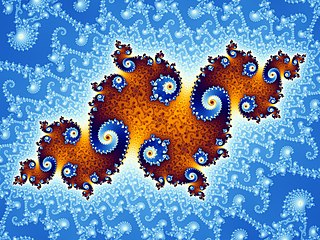
A Julia Island
(Courtesy Wikimedia Commons)
The question of whether such universally unpredictable events actually exist in our universe gets very deep very fast. It quickly bumps up against some of the most enigmatic and fundamental principles of physics, mathematics, computation, and theology. Together, these principles define the boundary of the known universe. And by that, I don't mean just the limit of what we know today, to be extended as we learn more tomorrow. I mean the absolute limits of science and reason, beyond which we can never venture, no matter how clever we are.

For a long time, I've been fascinated with a set of theorems that seem to define that boundary. They include the following:

  • Heisenberg's Uncertainty (Physics) — There is a limit to how accurately we can measure the properties of physical objects.
  • Bell's Inequality (Physics) — That limit applies not just to our ability to measure things accurately, but to our fundamental ability to know things about physical objects.
  • Gödel's Incompleteness (Mathematics) — Any attempt to explain everything using a small(er) set of axioms is doomed to be either unfinished or wrong.
  • Turing's Undecidability (Computing) — There are infinitely many problems that cannot be solved by any digital computer.
  • Chaitin's Irreducibility (Computing & Mathematics) — Almost every number (probability = 1) is "random" in the sense that it cannot be computed by an algorithm that is much shorter than the digits of the number. That is, the shortest name for the number is the number itself. Randomness exists in mathematics as well as physics!

I will talk more about these ideas and theorems in later posts in this series (informally of course - please don't confuse me for a real physicist or mathematician). For now, notice the last word in their names. Each of them expresses a negative. Each of them tells us something about what we cannot do, where we cannot go, what we cannot, under any circumstances, know.

Intuition suggests these five principles, despite their different fields of application, are somehow related. In fact, they seem to be exactly the same, or at least stem from the same underlying phenomenon. Namely this:

Fundamental randomness exists. It isn't just a small wart on our logical world, but rather an unfathomable ocean surrounding it. We cannot ever know what goes on in this ocean of randomness. We can only glimpse the shape of the coastline of our little island of reason, as the theorems and principles listed above begin to illuminate.

Thursday, July 19, 2012

And the Winner is Probably...


In Provably Probable Social Choice I talked about the Gibbard-Satterthwaite theorem and its somewhat depressing conclusion that no deterministic voting system can completely prevent dishonest/tactical voters from unfairly influencing elections. Also in that post, I compared this social choice theorem with a similar result in distributed computing, Byzantine Agreement. In both realms, it seems that randomness must be an essential ingredient in any full solution.

There are many good, efficient solutions to various distributed computing problems that are probabilistic in nature. But what about random voting? The very idea seems silly. But is it?

In fact there has been a good bit of recent research into probabilistic voting algorithms that is starting to yield some interesting results.  For example, weighted lottery voting basically puts all the votes into a hat and chooses one at random. The single ballot chosen determines the winner. Surprisingly perhaps, this simple probabilistic procedure may be a good way to elect legislatures with multiple representatives from multiple districts. One reason is that it is completely immune to tactical voting.

Suppose that, for a given weighted lottery election, candidate A has 60% of the votes, candidate B has 30%, candidate C has slightly less than 10% and candidate D has only a single vote. With this voting procedure, the favored candidate will probably win the election. But there is some chance A will lose in favor of B or C. And there is even a small chance that candidate D, with only a single vote, will win! I know what you're thinking — this isn't practical. But think what happens when we do this for each member of a legislature, say a hundred representatives, all elected from their individual districts using weighted lottery voting. In the end, the distribution of representatives will conform to the distribution of voters across all districts. Yes, there may be some anomalies in the state house, so to speak, but if you trust the laws of probability (and I do), the overall make-up of the legislature will reflect the opinions and expressed wishes of the electorate. Now, I don't know of anyone who has seriously suggested that weighted lotteries be used in real world elections, but it is nonetheless tantalizing to look at some of the practical advantages to be gained by doing so.

First, like most probabilistic algorithms in the field of distributed computing, this procedure is dirt simple. There is no tallying of votes, no backroom subjective judgement about which ballots to count and which to ignore, no arithmetic of any kind involved in determining who the winner is. You simply put all the ballots into a basket (physically or electronically), shake it up, and then have a good-looking spokesmodel choose the winner. This procedure will likely promote higher voter turnout. With most of the deterministic voting schemes in use today, a voter who finds herself in an extreme minority may decide to skip the whole voting hassle if she feels there is absolutely no way her vote will matter. With the probabilistic scheme, however, there is always a possibility her vote will not only matter, but completely determine the outcome of the election! Similarly, there will be higher candidate participation because this algorithm (unlike winner-take-all deterministic plurality algorithms) does not inherently favor a two-party system. It is always possible for a third party to win an election.

The most promising advantage of probabilistic voting schemes like this one is that they are impossible to "cheat." More precisely stated, the best way to get your favorite candidate to win is to actually vote for him. This is not the case with any deterministic voting algorithm if there are four or more candidates. You might say, well, cheating isn't very common because it's so hard for individual voters to devise effective cheating strategies. Not so. In fact, there is one kind of cheating that is especially widespread and particularly destructive: the gerrymander. Ruling parties, with the help of computer software, commonly re-draw district lines so as to minimize or completely remove the voting influence of those who would vote against them. This practice is completely legal, completely constitutional, and completely despicable. And it works solely because of our choice of voting systems. Perhaps the most egregious example of gerrymandering in the entire US occurs in my home town of Austin, Texas. In congressional District 25, shaped like the practice's namesake salamander, Austinites share a voting pool that stretches hundreds of miles to the South, all the way to the Mexican border. No one disagrees the only purpose for this strange arrangement is to cheat in the congressional elections. A probabilistic voting scheme, like weighted lottery voting, would completely eliminate the gerrymander. As long as districts contain an equal number of voters, as required by the Supreme Court, the ideological composition of the legislature will, with high probability, reflect the ideological distribution of the voters.

But this simple probabilistic voting scheme is only remotely practical for legislative-type elections, where the, perhaps, negative effects of an improbable choice of representative can be diluted by all the other members of the legislature. The method is ill-suited for executive elections where a single, powerful governor or president is chosen by chance. For those kinds of elections, you really want a probabilistic algorithm that usually honors the majority choice, if there is one, and steps in with a coin flip only when it needs to. One example of that sort of algorithm is called double range voting.

With this clever, though more complex, voting procedure, each voter casts two ballots (or one ballot with two sub-ballots), awarding preference points in a given range, say zero to five stars, to each of the candidates. The first range ballot is tallied to identify the first-, second-, and third-place winners. Usually, the first-place winner is chosen as the winner of the whole election and we're done. But there is a (tunably small) chance the algorithm will ignore the first-place choice and pick the winner to be one of the second- or third-place candidates instead. In that case, the second ballot is used to make the binary choice. Since binary choices are immune to the Gibbard-Satterthwaite limitation, there is no reason for voters to vote tactically on the second ballot, and since it isn't possible to know which candidates will be #2 and #3, the second ballot may just as well be a completely honest reflection of the voter's choices among all candidates. Obviously, this is not a mathematical proof, but I'm sure you get the idea. The outcome is, usually the majority candidate wins, but sometimes the second or third most favored candidate wins, and as reward for suffering this small uncertainty, the election becomes immune to tactical voting.

These and other probabilistic voting procedures all suffer the same drawback: lack of transparency. When the outcome of an election involves a random choice, how do you prove ex post facto that the choice was indeed random? If I randomly choose a number, say 42, how can I prove to you my choice was just as likely as any other integer? How do I prove that the good-looking spokesmodel didn't use sleight of hand to deliberately choose a certain ballot out of the basket? More practically, how do I prove that the computer-generated random selection was indeed, random? If I use a physical process to generate a random selection, like repeatedly flipping a "fair" coin, how can you be sure the coin was really fair? And for the deeply paranoid (or inquisitive) among us, how do we know there is even such a thing as randomness? Maybe everything in the universe is predictable, if you just have a big enough computer.

My next few posts will examine these kinds of questions from the points of view of computer science, physics, mathematics, and theology. Given the demonstrated importance of randomness in distributed computing and social choice, we should at least investigate whether it actually exists.

Tuesday, March 6, 2012

A Random Story

So randomness and probabilities are inevitable parts of any discussion of distributed consensus. Just how comfortable are we with the fact that our daily choices must be guided, at least in part, by the laws of probability?

When we get behind the wheel of an automobile or strap ourselves into an airplane seat, we are literally trusting our lives to the laws of probability. Since we can't know everything about the pilot of the airplane or the other drivers on the road with us, we wrap ourselves every day in the comfortable knowledge that, with high probability, we will survive to see another day.


But when it comes to computer programs and programmers, we are much more demanding. We expect computers to be deterministic. Period. They perform exactly the same instructions over and over and any deviation from that determinism we call a "bug" or a "fault." We demand that our family photos be kept safe even in the eventuality of multiple, byzantine faults. When you check yourself into a hospital, the chances that an accident or mistake will lead to the loss of your life are quite a bit higher than the chances that an accident or mistake will result in the loss of that kitty cat picture on Facebook. (Small caveat: I totally made that up.)

The fact is, we accept that the universe is stochastic but demand that computers be deterministic. Here's a true story about how I once forced a customer of mine to face that bias and, I hope, start to change his attitude a bit.

While I was at Caringo (they probably still do this) we would periodically conduct training classes for customers of our products, which includes CAStor, a scalable, distributed object storage solution. I would typically join the students and instructors for lunch one day to answer any technical questions they had about the products.  During one such training class, I learned from the instructors that one of the students was being vocally skeptical about one of the foundational assumptions we had made in the product.

CAStor can store billions, even trillions of distinct data objects, each of which has a universally unique identifier (UUID) associated with it.  Other similar products on the market generate these UUIDs in a deterministic fashion that necessarily involves a central naming authority - an expensive and fragile solution IMHO. CAStor's innovation in this area was to instead use a large truly random number for these UUIDs, removing the requirement for a central authority and significantly simplifying the generation and management overhead.

Using this mechanism, the chances that two distinct objects will be assigned exactly the same UUID are very, very, very (to the 42nd power) small. But it is possible and, of course, it would be a bad thing if it happened, which is exactly the objection being raised by our skeptical student.  I mean, we're talking about computers here, and he expected a deterministic guarantee that such a collision is not possible.

So I expected a question along these lines during our meet-the-architect lunch. But it didn't come.  At the end of the lunch, after we'd all finished our deli sandwiches, I decided to bring up the topic myself. I went into the kitchen of our corporate offices and retrieved a wine glass that had been sitting on the top shelf collecting dust. Back in the training room, I tapped the glass with my pen to get everyone's attention and, without saying a word, placed the glass into my empty lunch sack, twisted it shut, and put it on the conference table. Then I picked up a heavy metal power strip and, again without a word to the class, pounded the sack with the power strip until the glass was thoroughly shattered.

Everyone moved away from me there in the training room. The instructors, whom I hadn't warned about this, considered calling building security.

After a brief pause for effect, I picked up the lunch sack and began shaking it vigorously. Then I asked, "Who here believes the glass will spontaneously reassemble itself if I keep shaking the bag?"

No one answered. So I upped the ante.

"What if I continue shaking it like this all day?  All year?"  Nobody answered.

"What if I continue shaking the sack for the rest of my life? Who believes the glass shards will accidentally find their way back in the exact same configuration they started in to reform the wine glass?"

Finally, the troublemaker student answered. He timidly said, "Well, it could happen."

"Exactly," I said.  "It could happen. And if any of you believe it actually will, I recommend you should not buy our product." And I left the room.

I'm happy to report that our "troublemaker" student became a big believer in our product and is still a customer.

Sunday, March 4, 2012

Provably Probable Social Choice

There is a strong theoretical similarity between computer networks and people networks. Here we will discuss a surprising fact that has been proven to be true for both human and computer networks.

Without a coin to flip, there is no safe way for independent entities to reach consensus! 

The previous chapter contained a light treatment of a fairly heavy theoretical topic in computer science, Byzantine Agreement (BA), and an exploration of how randomness is an essential requirement in overcoming certain impossibility results in distributed computing. As it turns out, there are some tantalizingly strong similarities between the theory of distributed agreement and the theory of social choice (SC).

Recall that the BA problem setup involves a number of distributed processes each of which starts out with an initial value for some variable. We might call this initial value the "authentic" or "honest" value of a process, because all properly functioning processes will honestly report this value to all others. The goal of any BA algorithm is to allow the processes to vote for their authentic value and to compute, eventually, a global value in such a way that two straightforward requirements are met:
  1. If all well-behaved processes have the same authentic value, then the global consensus value must be that value.
  2. If the well-behaved processes do not all agree on the same authentic value, they must still agree on some global value; it doesn't matter which one.
To make it more interesting, the problem allows for the possibility of faulty processes that do not honestly report their authentic value choices but rather attempt to game the system to influence the agreed upon result, or to prevent any agreement from being reached. If we place no constraints at all on the types of failures the faulty processes can experience, then we may as well assume the nefarious nodes are consciously trying to thwart our algorithm and that they have complete access to all the information they need to do so.

Already we can start to see similarities between BA and SC (voting) problems. We have a number of independent processes (voters), each of which has its own preferred value (candidate) and they must report (vote) in order to agree on (elect) a global winner in a fair manner. Some of the entities may be faulty (dishonest) and instead report (vote) strategically, using information about partial results to unfairly game the system in favor of their authentic choice.
Terminology note: The social choice literature seems to use the terms "strategic voting" and "tactical voting" interchangeably to mean voting for some candidate who is not your authentically preferred one in order to try to influence the election in your favor. Here we will use "tactical voting" because it describes better what's actually going on.
A very interesting question to ask for both BA and SC is this: Is it possible to devise an algorithm in which the non-faulty (honest) processes (voters) can overcome the evil impact of one or a few faulty (dishonest) ones so they cannot unfairly influence the result?  Not surprisingly, many mathematicians have examined this and similar questions and, perhaps surprisingly, the answers have been rather discouraging.

In the area of Byzantine Agreement, it was proven in 1985 that, for any practical scenario (where, e.g.,  message delivery times are unpredictable) there is no deterministic algorithm that will prevent even a single faulty process from influencing the results of the agreement. All the great work and research to find solutions in this area depends on randomness in some way to solve this important problem.

So what about the Social Choice arena? Around the same time (1984) Michael Dummett published several proofs of a decade-old conjecture now called the Gibbard-Satterthwaite theorem which is about voting algorithms used to select one winner from a group of three or more candidates based on voters' preferences. To paraphrase, the theorem states that for any reasonable scenario (where, e.g., there are no blacklisted candidates and the winner is not chosen by a single dictator) there is no deterministic algorithm that will prevent even a single tactical voter from influencing the results of the election. Sound familiar?

There is a more well-known, but in some ways less interesting, result in social choice called Arrow's Impossibility Theorem that has a lot in common with the G-S theorem discussed above. Dr. Kenneth Arrow received the Nobel Prize in Economics for his work related to this theorem in 1972. Professor Nancy Lynch received the Knuth Prize in 2007, in part for her seminal work on the impossibility proof for Byzantine Agreement. Yet, as near as I can tell, neither discipline has cited the other in all these years, despite the striking similarities of the problems and results and the huge amount of research activity associated with the two independent fields.

Don't get me wrong. I'm not saying these two canonical problems are identical, or even that there is a common underlying body of theory (though I believe there very well might me). But even the differences in the problem statements are illuminating and may indicate areas for further research in one field or the other. For example, the BA problem statement requires every non-faulty process be able to independently compute and verify the agreed upon value. There is no central authority to tabulate votes in BA, whereas in SC, it is typically assumed the independent voters submit their preferences which are then tallied in one place by a trusted central authority. But would it be a useful requirement for each voter in a SC scenario to be able to independently verify the results of an election? I believe this could be the basis of a reasonable formal definition of election transparency, a very useful property of real elections.

There are also areas where the typical formulations of SC problems are actually more stringent than BA. Remember the validity requirement for BA is, if every non-faulty process begins with the exact same initial value, then the algorithm must choose that value. If even one good process has a different value, then a correct BA algorithm is free to choose any value at all, as long as everyone agrees with it in the end. For SC, however, we must agree to elect a candidate based on more flexible requirements. An alternative validity rule might be, if a plurality of non-faulty processes have the same preferred value, the algorithm must choose that value. Or more generally, the algorithm must choose the winning candidate such that voters are the least unhappy about the result. This suggests some interesting extensions to the BA problem, such as Synchronous Byzantine Plurality.  I have no idea whether that problem has been studied or results reported in the literature, but reasoning by analogy (always a tricky thing to do) with the Gibbard-Satterthwait theorem, I would guess that synchronous BA with a plurality rather than unanimity constraint would be impossible in a deterministic way.

Despite all the interesting complexities with these two fields of study, one can definitively say that no completely robust solution to either BA or SC is possible without randomness. Faulty and/or malicious participants can always overwhelm honest participants to influence agreements and elections.  Without a coin to flip, there is no safe way for independent entities to reach consensus!

Wednesday, January 26, 2011

Provably Probable Is Better Than Probably Provable

Randomness and distributed algorithms are often found together, like movie stars and orphans. It's not just that distributed algorithms often exhibit stochastic behavior, which they do; randomness is also an essential ingredient of many distributed solutions. I'm not speaking loosely when I use the word "essential" here. There are many problems in the distributed arena that are provably impossible to solve deterministically, but if you give processes access to a fair coin and allow them to flip it occasionally, voila!, an efficient, reliable solution emerges that yields the correct behavior. Probably.

The first time I encountered this was with a canonical problem in distributed fault tolerance, called the Byzantine Agreement problem. Don't Google it! There's been so much written and so many results about the topic over the last thirty years that you'll never return if you vector off now. Instead, let me present a concrete instance of the general problem in order to talk about why randomness is such a useful, and in some cases essential, part of the solution.

Suppose there are four computerized weather stations distributed about a certain city. Each station has, among many other sensors, a light detector, and the stations can communicate with each other via whatever protocol we wish to devise. Every hour, on the hour, each station samples its own light sensor and makes an independent judgement about whether it is "daytime" or "nighttime." At noon and at midnight, it is highly likely that all stations will make the same assessment about whether it's day or night. But at dusk and dawn, local variations in light and sensor sensitivity will probably cause the stations to arrive at different conclusions about which is the best classification. Our job is to devise an algorithm and a protocol that allows the stations to all agree on a single answer, and that has two very reasonable properties: 1) if all the stations individually come to the same conclusion about whether it's day or night, then the group must agree on that answer, and 2) even if they don't start out with the same answer initially, they must still agree on some value (it doesn't matter which).

But wait, there's no villain in this story yet. One of the stations doesn't follow the rules. It can say anything at any time to any other station without constraint. Maybe it's faulty, or maybe it's nefarious. Crazy or evil -- it doesn't matter. We may as well assume the bad guy is a malicious spy who knows everything that has happened, using that information to thwart our little plot and prevent the remaining stations from agreeing whether it's day or night. Now there's a worthy antagonist.

There is a simple, but subtly wrong, deterministic algorithm that attempts to allow the three non-faulty stations to reach agreement at all times of the day or night, even with the omniscient meddling of the faulty one. It goes like this: Each station sends its initial value to every other station. After collecting all four values (including its own), each station determines whether three of the four responses have the same value. If so, the station takes this value as its final answer. If it's a tie, the station picks a predetermined default, say "daytime," and the nodes exchange values in another round of communication. The algorithm terminates when all the correct nodes have chosen the (same) final answer.

You can see that, if it's noon or midnight and all three non-faulty stations report the same value, there is little the nefarious foe can do to confuse this algorithm; they will all see at least three identical answers and immediately choose it. There is danger at dusk or dawn, however. We're still okay if two of the non-faulty stations thinks it's day and the other one thinks it's night. In this case, there's no way the nefarious foe can influence the vote so that "nighttime" is chosen by any of the non-faulty stations. They will all pick the default value, "daytime," after the first round and confirm it as the agreed value on the second round.

The remaining case is vulnerable to attack. When two of the non-faulty stations initially think it's night and the other thinks it's day, the nefarious foe, in full omniscient glory, can whisper "nighttime" to the nighttime stations and "daytime" to the daytime station. The nighttime stations will therefore continue to vote nighttime, because they see three votes for that value, while the minority station will continue to choose the default value, "daytime." Thus, the faulty foe can ensure the stations never reach agreement on any value.

Surprisingly, this simple but incorrect deterministic algorithm can easily be converted to a simple and correct probabilistic one, just by giving each station a fair coin to flip. Instead of picking a predetermined default value (which is subject to being discovered and exploited by the evil one), each station flips its coin in the event there are not three votes for the same value. Heads, it's daytime, tails it's night. If the non-faulty stations do not unanimously agree, The Faulty One can still influence one of the two cases, as described above, but since it cannot predict the value of the coin flip (that's what random means) there's no way to tell which is the vulnerable case. There's only a 50% chance our malicious adversary will be able to thwart agreement on any given round, so if we just keep repeating the algorithm round after round, the stations will eventually reach agreement, despite the best efforts of the know-it-all evil station.

Probably. We have a choice with this probabilistic algorithm. We can either stop it after a fixed number of rounds, and accept the (tunably small) possibility that agreement has not yet been reached, or we can run it until agreement is reached, and accept the (tunably small) possibility that it takes so long we no longer care whether it's night or day. This exact trade-off is typical of distributed, probabilistic algorithms.

To be fair, there is a simple deterministic algorithm that solves this problem (see the seminal 1980 paper by Pease, Shostak, and Lamport), but it depends on a subtle condition that doesn't always exist in real-life distributed systems -- synchronous communication. Another famous result in this research area is that of Fischer, Lynch, and Paterson, which proves no deterministic agreement algorithm can exist unless we can give, with certainty, an upper bound on how long it will take messages to be delivered between processes (weather stations in this case). And yet, there are many good probabilistic solutions to this important practical problem!

Back in 1987, a fellow graduate student at the University of Texas at Austin, Russell Turpin, and I were struck by this result. So much so that we spent several months reading and analyzing the plethora of research on probabilistic agreement and writing a survey paper on the topic. Now, twenty-five years later, Dr. Turpin and I are still friends and colleagues, and we expect our interest and passion for distributed solutions to continue for many more years to come.

Probably.